
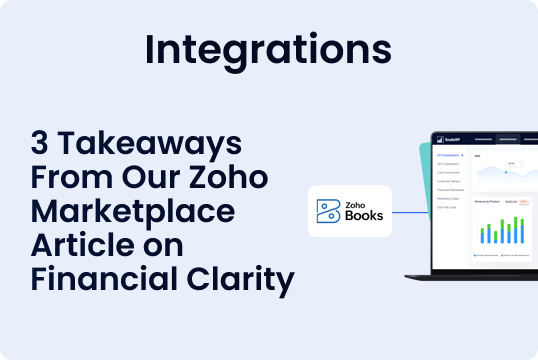


We recently partnered with Zoho Books on a guest article about a challenge most growing businesses know well: financial data is everywhere, but clear answers are still hard to find.
Revenue lives in the accounting system. Customer and pipeline data sit in CRM. Billing often lives somewhere else. By the time leadership needs a clear picture of performance, finance is left stitching together reports across multiple tools.
That is exactly the issue we explored in our Zoho Marketplace article. The core idea is simple: better decisions start with better financial clarity.
Below are three key takeaways from the piece, and why they matter for finance teams and business leaders trying to move faster with more confidence.
Key takeaways
- Financial data becomes useful when accounting, billing, and CRM are connected into one trusted view.
- Automation gives finance teams time back and shifts their role from manual reporting to strategic insight.
- Leaders need instant, reliable answers on performance, not more static reports built after the fact.
1. Financial Data Only Becomes Valuable When It Is Connected
Most businesses do not have a data shortage. They have a clarity problem.
Accounting systems record transactions. CRM systems track deals and customers. Billing platforms handle subscriptions, invoices, and payment events. Each system tells part of the story, but very few companies have one place where that story comes together cleanly.
That gap creates friction across the business. Finance spends time validating numbers across tools. Founders wait for answers that should already be available. Leadership meetings become slower because confidence in the data is weaker than it should be.
Connected data changes that dynamic. When finance, billing, and CRM are unified, the business gains one living source of truth. Revenue, churn, cash, and performance metrics become easier to trust and much easier to explain.
For example, instead of reconciling ARR manually across exported reports, a connected finance intelligence layer can align CRM activity, billing records, and accounting data in one place. That turns fragmented reporting into real-time clarity.
This is where financial complexity starts to become manageable. Teams stop chasing numbers and start using them.
2. Automation Changes the Role of Finance
Many finance teams are still doing work that should no longer be manual. Exports, spreadsheets, reconciliations, and repeated report building consume time every month, even when the underlying question is straightforward.
The cost is not just inefficiency. It is lost capacity.
When finance is buried in manual reporting processes, the team has less time for analysis, less room to guide strategy, and less confidence when leadership needs fast answers. The business feels this in slower decisions, inconsistent reporting, and unnecessary month-end pressure.
Automation changes the operating model. Instead of building reports from scratch, finance teams can work from live, structured data that is continuously refreshed and validated. That means less manual intervention, fewer spreadsheet dependencies, and more time spent on insight.
In practice, this could mean automated revenue schedules replacing manual tracking, or dashboards that update instantly as source data changes. It could mean reducing repetitive reconciliations so finance can focus on trends, exceptions, and performance drivers.
This is the real value of automated finance intelligence. It gives teams relief from manual work, and the control to lead with confidence.
3. Leaders Need Answers, Not More Reports
Leadership teams rarely ask for more reporting. What they want are answers.
How is churn trending. What is driving margin movement. Which customer segments are growing fastest. Where is performance improving, and where is it slipping. These are the questions that shape decisions, and they cannot wait for static monthly reporting cycles.
When systems are disconnected, even simple questions take too long to answer. Finance has to pull data together manually, validate it, and explain inconsistencies before insight can begin. By then, the moment for action may already have passed.
When data is connected and reporting is automated, answers become instantly accessible. Leaders can move from top-line KPIs to customer-level detail without relying on manual work behind the scenes. That speed creates a very different decision environment.
Instead of reacting after month-end, businesses can operate with live visibility. They can spot trends earlier, challenge assumptions faster, and make decisions with greater authority because the underlying numbers are current and trusted.
That is what modern finance should enable: instant answers, stronger alignment, and confidence in every decision.
Why This Matters
Financial clarity is no longer a nice-to-have for growing businesses. It is part of how companies operate well.
As systems multiply and reporting requirements grow, the old model of stitching together spreadsheets becomes harder to defend. Leaders need a clearer, faster way to understand performance. Finance teams need more time for analysis and less time spent building reports that are outdated almost immediately.
Connected systems and automation solve that problem at the root. They create clarity, speed, and confidence by turning fragmented financial data into one trusted view of the business.
That is the shift we explored in our Zoho Marketplace article, and it is the direction modern finance teams are moving toward.
Read the Full Article
We cover these ideas in more detail in our guest article with Zoho Books, including why disconnected systems slow decision making and how modern finance teams are creating one trusted source of truth across the business.