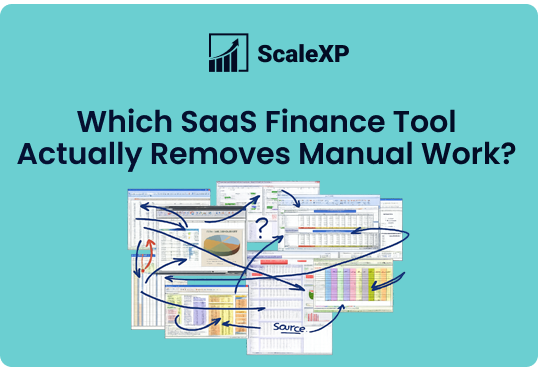


Most SaaS finance teams have already invested in what looks like a complete operating stack. HubSpot captures commercial activity, Xero records financial outcomes, and SaaS Grid sits between them to improve connectivity. On the surface, that should create a cleaner finance process.
And to a point, it does. SaaS Grid brings more structure to the relationship between CRM and accounting data, which makes it easier to see what is happening across systems and reduces some of the manual movement of information between tools.
The issue is that finance still ends up doing the work that matters most. Deferred revenue schedules still need to be managed. Accruals and prepayments still need attention. ARR, MRR, and churn still need to be rebuilt, checked, and explained before leadership can rely on them.
That is where the difference in the SaaS Grid vs ScaleXP comparison becomes clear. SaaS Grid helps structure data across systems. ScaleXP removes the manual accounting and reporting work that still exists after integration.
Key takeaways
- SaaS Grid improves connectivity between CRM and accounting systems, but it does not produce decision-ready financial outputs on its own.
- Finance teams still rely on spreadsheets for reconciliation, SaaS metrics, and reporting once complexity begins to grow.
- At roughly $1,000 per month for a typical ~$2M ARR setup, SaaS Grid can add structure without removing the core finance workload.
- ScaleXP removes that workload with fully automated journals, a single source of truth across systems, real-time SaaS metrics, and streamlined invoicing.
- The real decision is not which tool looks better. It is which system removes the most work between raw data and a number finance can trust.
The Modern SaaS Finance Stack Looks Complete — But Still Feels Fragmented
Most SaaS finance teams have already invested in the “right” systems. HubSpot captures commercial reality, Xero captures financial history, and SaaS Grid connects the two. From a systems perspective, that sounds like a complete stack.
But a connected stack is not the same as a finance-ready one. CRM shows what is likely to happen next through deals, pipeline, and contract values. Accounting records what has already happened through invoices, payments, and journals. SaaS Grid helps bring those two worlds closer together by syncing and structuring data across them.
The expectation is straightforward: if the systems are connected, finance should have a single version of truth. In practice, the experience is more complicated. When leadership asks for ARR, churn, retention, or forecast accuracy, finance often still pauses. The data may be visible, but it still needs to be reconciled, adjusted, and validated before it becomes a number the business can confidently act on.
That is why many SaaS finance teams discover that integration solves part of the problem, but not the final step between data and decision.
What SaaS Grid Does Well
This comparison only works if SaaS Grid is described fairly. It plays a useful role in the finance stack, especially for companies moving beyond disconnected systems and trying to create more consistency between CRM and accounting data.
Data connectivity and structure
SaaS Grid helps align CRM and accounting datasets, which reduces some of the manual effort that normally comes from exporting reports and stitching them together in spreadsheets.
Improved visibility across systems
By bringing pipeline and financial data closer together, it gives finance and leadership a more organized reporting foundation than they would have with fully separate systems.
A meaningful step for growing SaaS companies
For companies early in their operational maturity, that can be valuable. It often marks the point where finance begins moving away from disconnected tools and toward a more structured reporting environment.
The problem is not that SaaS Grid fails to add value. It is that, as complexity grows, finance still ends up owning the hardest and most time-consuming parts of the process.
Where SaaS Grid Reaches Its Limit for Finance Teams
This is where the real comparison begins. The question is not whether SaaS Grid connects systems. It does. The question is what still sits outside the platform once finance needs board-ready numbers rather than connected datasets.
Integration does not equal interpretation
Even when data is synced successfully, it is not automatically reconciled. Timing differences still exist, and revenue can appear differently across CRM activity, invoice timing, and accounting treatment. Finance still has to interpret what the data means before it becomes usable for reporting.
Metrics still need to be rebuilt
ARR, MRR, churn, retention, and expansion metrics often still need to be calculated outside the system. In practice, that means spreadsheets remain in the process even after integration has been implemented.
Month-end still requires manual intervention
For SaaS companies, this is where most of the real finance work still happens. Deferred revenue schedules are often still built manually, accruals and prepayments are still managed outside the system, and reconciliation between CRM and accounting still needs to happen before reporting can be finalised.
In other words, the most time-consuming and error-prone finance tasks remain in place.
The real issue is not access — it is trust
The data exists, but finance still has to reconcile, adjust, and validate it before it can be shared confidently. “Let me confirm that” becomes a standard part of the reporting process.
SaaS Grid structures the data. Finance still has to turn that data into trusted answers.
The True Cost of SaaS Grid: More Than the Subscription
The pricing conversation is often framed too narrowly. Subscription cost is visible and easy to compare, but the more important issue is the operational cost that continues to sit around the software.
The visible cost
For a roughly $2M ARR SaaS company using two Xero entities and HubSpot, SaaS Grid will typically land around the $1,000–$1,100 per month range.
The invisible cost
The larger cost often sits outside the subscription itself: time spent rebuilding SaaS metrics, manual deferred revenue and accrual workflows, spreadsheet maintenance, reconciliation between CRM and accounting, and delays in producing numbers leadership can actually use.
Why this cost compounds as you scale
As the business grows, the reporting burden usually grows faster than the software stack. More customers create more revenue complexity. More entities create more consolidation work. More scrutiny from leadership and investors creates pressure for faster, clearer answers.
The subscription is predictable. The manual finance work is not.
SaaS Grid vs ScaleXP Pricing: What Are You Actually Paying For?
At first glance, this looks like a straightforward comparison. One platform structures data across systems. The other is a finance automation platform. But for finance leaders, the more useful question is what work still remains after implementation.
Typical SaaS Grid cost at ~$2M ARR
For the setup described above, SaaS Grid generally lands at approximately $830 per month for the base platform, plus around $200 per month for users, taking the total to roughly $1,000–$1,100 per month.
What that cost delivers
That spend gives finance teams structured, connected data and better visibility across systems. That is useful, but it does not remove the finance work that follows.
What still sits outside the platform
Revenue recognition adjustments, accruals, prepayments, ARR and MRR calculations, and the final reconciliation and validation process still need to happen somewhere. In many cases, they still happen manually.
ScaleXP pricing at the same stage
ScaleXP pricing for comparable SaaS companies typically lands in the following range: Starter at $125 per month, Growth at $350 per month, and Scale from $500 per month, with additional entities priced separately depending on tier. In many comparable setups, ScaleXP operates in the $350–$500 per month range.
What that cost replaces
ScaleXP is not simply another visibility layer. It removes a significant part of the work finance teams are still doing manually: deferred revenue and accrual workflows, spreadsheet-based metric calculations, reconciliation between CRM and accounting, and repeated validation cycles before reporting.
You can see the broader system view on the ScaleXP product tour.
The real comparison CFOs make
This is rarely a simple tool-versus-tool decision. It is usually a comparison between the cost of software and the cost of time, risk, and delayed decisions.
A practical comparison
SaaS Grid typically means around $1,000+ per month, plus ongoing manual finance work, reconciliation between systems, and continued spreadsheet dependency.
ScaleXP typically means around $350–$500 per month, plus automated journals and accounting workflows, real-time metrics from integrated data, and a significantly reduced manual workload.
The question is not which tool is cheaper. It is which system removes the most work between data and a trusted number.
SaaS Grid vs ScaleXP: Practical Comparison
The difference becomes clearer when viewed operationally rather than technically.
| Area | SaaS Grid | ScaleXP |
|---|---|---|
| Core function | Data integration | Finance automation + intelligence |
| Metrics (ARR, MRR) | Built manually | Generated instantly |
| Month-end | Manual adjustments | Fully automated journals |
| Reporting readiness | Requires validation | Ready in real time |
| Reconciliation | Required between systems | Eliminated |
| Spreadsheet reliance | Still required | Removed |
| Typical cost (~$2M ARR) | ~$1,000+/month | ~$350–$500/month |
The difference is not features. It is how much finance work remains after implementation.
Why Finance Teams Choose ScaleXP Instead
At a certain point, finance teams are no longer looking for better visibility. They are looking to remove the manual processes behind it. That is where ScaleXP becomes a different kind of decision.
Fully automated journals for SaaS accounting
ScaleXP automates deferred revenue, accruals, and prepayments, and posts journals with full audit trails. That matters because these are some of the most time-consuming and error-prone parts of SaaS finance. For finance teams trying to reduce close workload without compromising audit readiness, this is a meaningful operational shift.
You can explore this further on the ScaleXP month-end automation page.
A true single source of truth across systems
ScaleXP integrates CRM and accounting data into one consistent reporting environment. That means finance no longer has to spend hours reconciling between systems before numbers can be shared internally. The result is a true single source of truth across systems, not just a connected data flow.
Real-time SaaS metrics without rebuilding
ScaleXP calculates more than thirty SaaS metrics automatically, including ARR, MRR, churn, retention, LTV, and CAC. Because those metrics are built directly from integrated CRM and accounting data, finance teams no longer need to maintain spreadsheet models around the ledger.
You can review these capabilities on the ScaleXP SaaS metrics page.
Streamlined invoicing and quote-to-cash
ScaleXP also improves the flow between sales and finance. Invoices can be generated directly from CRM deal and quote data, which removes the need to retype information between systems and reduces billing errors. That creates a cleaner handoff from commercial activity to finance execution.
Built for complex SaaS reporting requirements
As the business grows, finance reporting usually becomes more analytical. Leadership wants reporting by product, customer type, cohort, segment, or business unit. Board and investor conversations require more than static accounting outputs.
Because ScaleXP combines integrated CRM and accounting data in one analytical environment, it becomes a far more capable system for complex SaaS reporting than an integration layer alone. Finance moves from assembling numbers to analysing them.
ScaleXP is not another layer on top of your systems. It is the system that removes the need to reconcile, rebuild, and revalidate your numbers.
When SaaS Grid Stops Being Enough
This shift is rarely planned. It usually becomes obvious under pressure, when finance is expected to produce faster answers with more confidence than the current process can support.
The signals are operational
Finance teams usually recognise the change when reporting takes longer each month, metrics are questioned more frequently, numbers are double-checked before being shared, and spreadsheets become critical to the reporting process rather than temporary support tools.
The underlying issue
Data is connected, but it is not decision-ready. The systems talk to each other, but finance still has to do the work required to turn those connected records into trusted outputs.
What changes at this point
At this stage, the problem is no longer integration. It is how much work is required before finance can trust the answer it is about to give.
Conclusion: From Connected Systems to Confident Decisions
SaaS Grid is a meaningful step forward. It helps connect systems, structure data, and improve visibility. But it is not the final system finance teams need once SaaS reporting becomes more demanding.
It does not eliminate manual finance work. It does not remove reconciliation between systems. It does not produce finance-ready answers on its own.
At a certain point, the issue is no longer how systems connect. It is how much work is required before finance can trust the output.
ScaleXP removes that work.
Replace Manual Finance Work After Integration
If your finance team is still reconciling between CRM and accounting, maintaining deferred revenue schedules manually, or rebuilding SaaS metrics in spreadsheets, the next step is not another integration.
It is a system that removes the manual work entirely and gives leadership faster access to numbers finance can stand behind.