

1. Blog
  2. Revenue recognition

IFRS 15 and ASC 606: Revenue Recognition in SaaS Companies

IFRS 15 and ASC 606 in plain terms: the five-step model, performance obligations, contract changes, deferred revenue and where the two standards differ.
Under IFRS 15, a SaaS company recognizes subscription revenue over the period it provides the service, usually in equal monthly amounts, not when it sends the invoice. Distinct services such as training are recognized when they’re delivered, and any contract discount is shared across everything in the contract. The worked example below takes one contract through all five steps.

What is IFRS 15?

The IASB introduced IFRS 15, a global accounting standard that explains how to recognize revenue from customer contracts.

Guess what? If you’re preparing financial statements using IFRS, you’ve got to follow IFRS 15. And it doesn’t matter if you’re a public or private company, a not-for-profit organization, or even a government entity.

For companies operating in the USA, read our article on ASC 606 revenue recognition.

So, why is IFRS 15 so important? Well, it ensures consistency and transparency in financial reporting across different industries and regions. By following IFRS 15, businesses can provide a clear and accurate picture of their revenue streams. This helps investors, stakeholders, and regulators make informed decisions based on comparable financial information. In short, IFRS 15 plays a crucial role in building trust and confidence in the global financial market.

At ScaleXP our platform automates revenue recognition and the schedules your IFRS 15 and ASC 606 reporting relies on. One Xero customer, Cue Technology, now saves 3–5 finance-team days every month.

What does IFRS 15 say about revenue recognition?

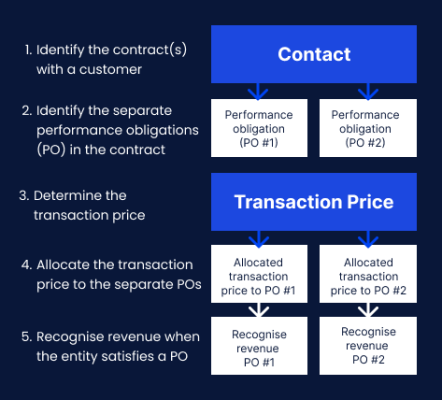
IFRS 15 has this five-step model for revenue recognition, and here’s what entities need to do:

  1. Spot the contract with the customer.
  2. Figure out the performance obligations in the contract.
  3. Work out the transaction price.
  4. Share the transaction price among the performance obligations.
  5. Record revenue when or as they fulfill a performance obligation.
AI revenue recognition workflow from invoices and CRM data to finance-reviewed schedules and journals

The IFRS chose this model because it provides a clear and consistent framework for revenue recognition across various industries and transactions. This approach ensures that financial statements reflect the true economic substance of business activities.

Worked example: the five steps on one SaaS contract

On 1 January 2026 a customer signs a 12-month subscription with a list price of $24,000, plus a training package with a list price of $6,000 that it could have bought from an implementation partner instead. Sales agrees a 10% discount on the whole deal. The customer is invoiced $27,000 upfront.

Step 1: Identify the contract

There is one signed contract, with agreed terms, a start date and payment terms. It is a contract under IFRS 15.

Step 2: Identify the performance obligations

There are two. The subscription is one obligation, satisfied over the 12 months. Training is a second, distinct obligation because the customer can benefit from it on its own and could have bought it elsewhere. (If the “services” were only internal set-up work that gives the customer nothing by itself, they would not be distinct, and the fee would be recognized with the subscription.)

Step 3: Determine the transaction price

List price $30,000, less the 10% discount of $3,000, gives a transaction price of $27,000. There is no variable consideration in this contract.

Step 4: Allocate the transaction price

The discount is shared in proportion to each obligation’s standalone selling price, not taken entirely off the training.

Performance obligationStandalone selling priceShareAllocated price
12-month subscription$24,00080%$21,600
Training package$6,00020%$5,400
Total$30,000100%$27,000

Step 5: Recognize revenue as each obligation is satisfied

The subscription is recognized evenly: $21,600 ÷ 12 = $1,800 a month. The training is delivered in January, so its $5,400 is recognized in January.

MonthSubscriptionTrainingRevenue recognizedDeferred revenue at month end
Jan 2026$1,800$5,400$7,200$19,800
Feb 2026$1,800–$1,800$18,000
Mar 2026$1,800–$1,800$16,200
……………
Dec 2026$1,800–$1,800$0
Total$21,600$5,400$27,000

The journals

When the $27,000 invoice is raised on 1 January:

AccountDebitCredit
Accounts receivable$27,000
Deferred revenue (contract liability)$27,000

At the end of January:

AccountDebitCredit
Deferred revenue (contract liability)$7,200
Revenue: subscription$1,800
Revenue: services$5,400

Every month from February to December: debit deferred revenue $1,800, credit subscription revenue $1,800. By 31 December the deferred revenue balance is zero.

What changes if the customer upgrades mid-term?

Suppose the customer adds seats on 1 July. If the extra seats are priced at your normal standalone selling price, IFRS 15 usually treats the upgrade as a separate contract, with its own schedule from 1 July. If the extra seats come with a discount, the usual treatment is to end the original schedule on 30 June and allocate the remaining and new amounts across the rest of the term. This is where spreadsheets tend to break: one upgrade means rebuilding the schedule, the deferred balance and every journal after it.

How does IFRS apply to software or SaaS companies?

Software subscriptions

Under IFRS 15, when software is a distinct performance obligation, you should recognize revenue over the subscription period (see revenue recognition methods).

If a subscription includes other goods or services, like maintenance and support, evaluate whether they are distinct performance obligations. If they are, allocate the transaction price among them based on their relative standalone selling prices, and recognize revenue for each distinct obligation throughout the subscription period.

Annual software licenses

When a subscription is a single performance obligation with a period of one year or less, recognize revenue evenly over the subscription period or use another method that better reflects the transfer of goods or services to the customer.

Multi-year software licenses

For subscription periods longer than one year, assess if significant financing components, such as the time value of money, are present in the transaction price. If you identify such components, adjust revenue accordingly.

Variable discounts

If a subscription has variable consideration, like discounts or rebates, estimate the variable consideration using the expected value or the most likely amount, whichever better predicts what you will receive, and include it only to the extent a significant reversal is not highly probable. Update revenue for any changes in estimated variable consideration in the period of change.

Upgrades and enhancements

Under IFRS 15, you should recognize revenue for software upgrades when the customer takes control, typically when the license period begins or activates.

Professional services

To recognize revenue for professional services or setup fees, determine if they are distinct performance obligations. If they are, recognize revenue when providing the service or setup fee to the customer. Recognize the allocated transaction price as revenue when transferring control of the service or setup fee to the customer.

If professional services or setup fees include variable consideration, such as discounts or rebates, estimate the variable consideration using the expected value or the most likely amount, whichever better predicts what you will receive, and include it only to the extent a significant reversal is not highly probable.

What are the criteria to comply with IFRS 15?

IFRS 15 requires revenue to be recognized as each performance obligation is satisfied: over time for a subscription, and at a point in time for something delivered once. Raising an invoice is not, on its own, a reason to recognize revenue. To follow IFRS, software companies must maintain accurate and complete customer contract information, including contract terms and service pricing details. Contracts can be written, oral, or implied by actions.

What are the major differences between ASC 606 and IFRS 15?

ASC 606 and IFRS 15 aim to ensure accurate revenue recording and recognition, providing clear, detailed guidance. Despite similarities, differences exist. For instance, IFRS 15 requires including variable consideration in the transaction price when it’s highly probable significant revenue reversal won’t occur. Meanwhile, ASC 606 requires including variable consideration as long as a significant revenue reversal is improbable.

Other differences that matter for SaaS companies:

  • Collectability. Both standards only treat an agreement as a contract if collecting the payment is probable, but “probable” means likely to occur under US GAAP and more likely than not under IFRS, so the US threshold is slightly higher.
  • License renewals. Under ASC 606, revenue from renewing a software license can’t be recognized before the renewal period begins. IFRS 15 has no equivalent rule, so the timing can differ.
  • Contract cost impairments. Under IFRS, an impairment of capitalized contract costs (such as sales commissions) can be reversed later; under US GAAP it can’t.
  • Policy elections. ASC 606 lets companies exclude sales taxes from the transaction price and treat shipping after the customer takes control as a fulfillment cost. IFRS 15 has no such elections.
  • Private companies. US private companies get some disclosure relief under ASC 606 that IFRS 15 does not offer.

Companies operating in multiple jurisdictions or considering global IPOs may need to comply with both standards, staying aware of their differences.

Applying either standard consistently gets harder as the subscription base grows. Our guide to SaaS revenue recognition and staying GAAP compliant as complexity grows looks at where finance teams most often lose control of the schedule.

Choosing a system is the next question: our guide to choosing revenue recognition software covers what to look for, and our article on what CFOs should expect from revenue recognition software covers how IFRS 15 and ASC 606 translate into system features.

How can software make compliance easier?

Xero and QuickBooks Online record the invoice. QuickBooks Online Advanced can also spread individual products or services over a service period. What usually falls back to spreadsheets is the rest of the five steps: allocating a contract’s price across obligations, handling upgrades and credits mid-term, and keeping the deferred revenue balance and journals in step every month.

ScaleXP connects to Xero and QuickBooks, reads your invoices and contracts, builds a schedule for each performance obligation and prepares the journals for your finance team to review and approve, then posts them back to your ledger with a full audit trail. It also covers accrued revenue, month-end close and 30+ SaaS metrics.

Software can automate the calculations and the evidence. Accounting policy, judgments and approval stay with your finance team.

The same connected data that produces IFRS 15 schedules also drives accruals, consolidation and reporting. Here is how the rest of the close automates once the revenue piece is solved.

Frequently asked questions

What is IFRS 15 in simple terms?

IFRS 15 is the international accounting standard that sets out when, and how much, revenue a company recognizes from contracts with customers. Issued by the IASB, it applies to any entity preparing financial statements under IFRS. It uses a five-step model: identify the contract, identify the performance obligations, determine the transaction price, allocate that price, and recognize revenue as each obligation is satisfied.

How is SaaS subscription revenue recognized under IFRS 15?

Under IFRS 15, SaaS subscription revenue is usually recognized evenly over the subscription period, because the customer receives the service as it is delivered. An annual subscription billed upfront is held as deferred revenue and released month by month. Setup fees, support or professional services are assessed separately: if they are distinct performance obligations, each receives its own share of the price based on relative standalone selling prices.

How does IFRS 15 differ from ASC 606 for subscription businesses operating in several countries?

IFRS 15 and ASC 606 share the same five-step model, so standard subscription revenue is generally recognized the same way under both. The differences sit in the detail, such as the constraint on variable consideration, where IFRS 15 uses a “highly probable” threshold and ASC 606 uses “probable”. Groups reporting under both frameworks, or preparing for an international listing, should document where their policies diverge and apply each consistently.

Can IFRS 15 and ASC 606 revenue recognition be automated?

Yes, IFRS 15 and ASC 606 revenue recognition can be automated once invoice and contract data is captured consistently, so each invoice’s service period drives the revenue schedule instead of a spreadsheet. ScaleXP connects to Xero and QuickBooks, builds deferred and accrued revenue schedules and journals from invoice data, and posts them back to the ledger with an audit trail after the finance team reviews and approves them.

How ScaleXP does this

ScaleXP builds revenue recognition schedules from your CRM contracts and prepares the journals for Xero or QuickBooks. Finance approves them before they’re posted. See how revenue recognition works in ScaleXP

Recognition schedule calculatorSee how an invoice turns into cash and revenueTry itClose
$
Invoiced$12,000
Cash received$12,000
Revenue recognized$3,000
Deferred revenue$9,000

Totals at the end of December 2026. Revenue is $1,000 a month. Click any month to move through the schedule.

ScaleXP prepares the schedules and journals for every customer, invoice and invoice line item, and finance reviews and approves them before they’re posted to Xero or QuickBooks.

Book a demo →

Invoiced in full at the start of the service period and recognized straight-line by whole month. Illustration only, not accounting advice.