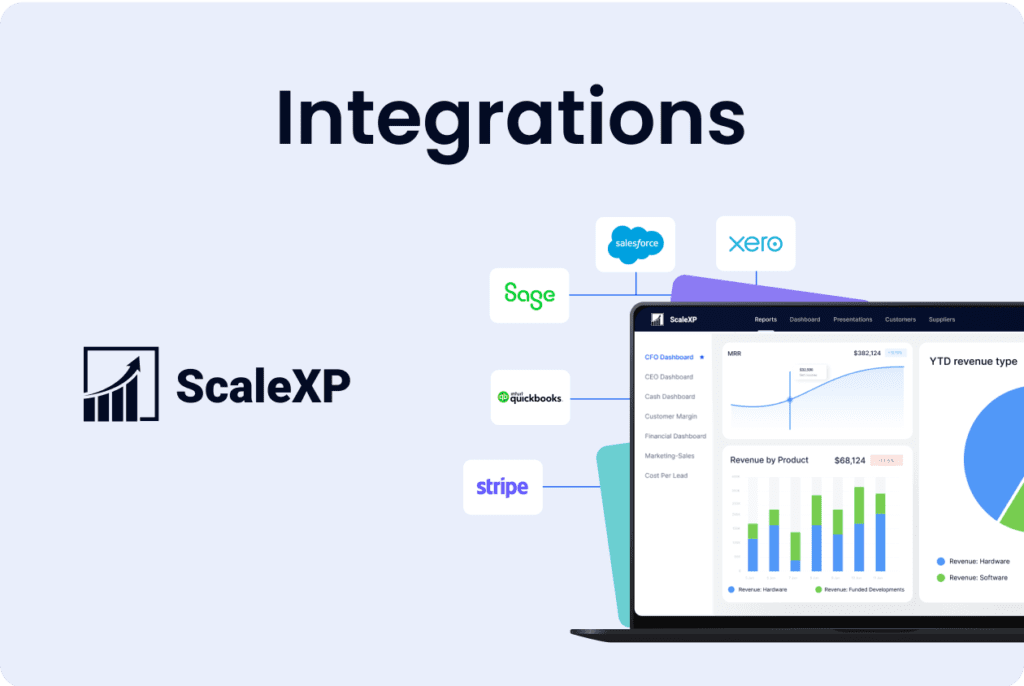


Ever wonder why your accounting and sales departments seem to operate in different universes? The robust accounting system QuickBooks, paired with the powerhouse CRM Salesforce, aims to close this divide. By combining these leading platforms, companies can unlock exceptional efficiency and deep analytics, driving rapid growth. Yet, navigating the integration process can be complex.
We explore the most practical methods for synchronising QuickBooks and Salesforce, revolutionising their interaction.
Your integration choices
Achieving seamless integration between QuickBooks and Salesforce can manifest in several ways, each offering distinct advantages designed to accommodate varied business requirements. Whether you’re after an easy, cost-efficient approach or need detailed customization, grasping the available choices is essential for finding the perfect fit for your enterprise.
ScaleXP
ScaleXP emerges as an excellent option for merging QuickBooks and Salesforce, particularly for those seeking a straightforward, economical solution:
Ease of Implementation: ScaleXP streamlines the integration journey, making it approachable for those lacking deep tech skills. This ensures a swift, fluid linking of your systems, allowing you to enjoy the advantages promptly.
Affordability: ScaleXP emphasises cost-efficiency, enabling smaller businesses to leverage the collective strengths of QuickBooks and Salesforce without breaking the bank.
Consistency and Speed: The service guarantees fast, consistent data sync between QuickBooks and Salesforce, ensuring your financials are always current and your sales team is content.
Learn how firms like yours have simplified their workflows using ScaleXP. Read more here.
Other QuickBooks + Salesforce integration alternatives
While ScaleXP provides a streamlined approach, other integration strategies include:
Plug-and-Play Solutions: These provide immediate integration, though they may be pricier and offer less customization.
In-House Customizations with APIs: Ideal for teams with internal tech resources, this method offers full customization control over the integration experience.
Middleware Platforms: Services like Zapier offer a compromise with some level of customization, though expenses can fluctuate based on the intricacy required.
Advantages of merging QuickBooks + Salesforce
Fusing these systems can significantly boost operational productivity and data precision, leading to:
Minimised Mistakes: Automated data transfers cut down on human errors.
Saved Time: Automation frees up your teams to focus more on expansion and client relations rather than manual inputs.
All-encompassing Financial Insights: Sales staff get a complete view of financial data within Salesforce, enabling superior decision-making.
Improved Client Relations: Integrating customer journeys provides enhanced customization and satisfaction.
Strategic Decision Support: A comprehensive operational view assists in informed decision-making and tactical planning.
The ScaleXP edge
ScaleXP isn’t just a bridge between QuickBooks and Salesforce; it’s the gateway to a streamlined, cost-effective, and high-performance business framework. With ScaleXP, you can anticipate:
Simplicity and Economy: Hassle-free setup and market-competitive pricing.
Optimized Data Handling: Precise, timely information exchange.
Empowered Strategic Expansion: Data-driven insights facilitating informed strategic moves.
Integration transcends mere technical alignment; it’s a pivotal business strategy with significant implications for your financial health.
Ready for a Business Revolution?
ScaleXP is dedicated to demystifying the integration process and driving your profitability. If your goals include operational efficiency, a holistic business view, or mastery over your data, explore what ScaleXP can deliver.
Unlock the complete capabilities of ScaleXP and see how it can empower your business. Book your no-cost personalised demo today!
How Salesforce Opportunity Data Maps to QuickBooks Invoices
One of the most time-consuming manual tasks for SaaS finance teams is re-entering deal data from Salesforce into QuickBooks to generate invoices. Every closed Salesforce opportunity contains the data you need: customer name, contract value, billing terms, service start and end dates. But without automation, a finance team member still has to open QuickBooks, manually create the invoice, and match it back to the deal — a process that introduces delays and errors at every step.
With ScaleXP, when a deal closes in Salesforce, the integration automatically maps that opportunity data to a QuickBooks invoice. The field mapping typically looks like this: the Salesforce Account becomes the QuickBooks Customer, the opportunity Close Date and Amount determine the invoice date and total, and custom fields like billing frequency or contract period drive line items and due dates. The result is that invoices appear in QuickBooks within minutes of a deal closing — without anyone touching a spreadsheet.
This matters especially for SaaS companies with high deal volumes, usage-based pricing, or multi-year contracts, where manual invoicing becomes a bottleneck at month-end. Learn more about automated Salesforce QuickBooks finance workflows.
Why Syncing Alone Doesn’t Solve Revenue Recognition
Most Salesforce QuickBooks integrations are designed to sync data — pushing opportunity records or invoice totals between systems. But syncing is not the same as revenue recognition. For SaaS businesses operating under ASC 606 or IFRS 15, recognising revenue correctly requires something more: a schedule.
When a customer signs a 12-month contract in January, the full invoice value cannot be recognised as revenue in January. It must be deferred and recognised ratably — one twelfth each month — over the contract term. A basic Salesforce QuickBooks sync cannot create that schedule. It will push the invoice amount to QuickBooks, but your finance team still needs to manually build the deferred revenue entries, track the recognition schedule, and post the journal entries each month.
ScaleXP fills this gap by reading the service period from the invoice or contract, building an automated recognition schedule, and posting the monthly journal entries directly into QuickBooks. This means your revenue is recognised correctly without manual spreadsheet work, and your month-end close is faster and more accurate. See why revenue data breaks at month-end and how to fix it.
For a deeper dive into the compliance framework, see our Salesforce revenue recognition ASC 606 guide.
Frequently Asked Questions
Does Salesforce integrate with QuickBooks natively?
Salesforce does not have a native, out-of-the-box integration with QuickBooks. Salesforce offers its own billing and CPQ tools, and QuickBooks has its own ecosystem, but the two platforms do not connect automatically. To integrate them, you need a third-party connector, middleware platform, or a purpose-built solution like ScaleXP. ScaleXP provides a direct, automated integration that keeps deal data, invoices, and revenue schedules in sync between Salesforce and QuickBooks without custom development.
What breaks at month-end when Salesforce and QuickBooks aren’t properly integrated?
Month-end close is where integration gaps become most visible. Common problems include: invoices not being created because finance wasn’t notified a deal had closed; revenue being recognised in the wrong period because the contract start date wasn’t passed through correctly; deferred revenue balances being maintained manually in spreadsheets that don’t reconcile with QuickBooks; MRR and ARR figures that differ between the CRM and the accounting system; and delayed close processes because finance teams are spending time chasing data rather than reviewing it. A well-configured Salesforce QuickBooks integration eliminates all of these issues.
How do I automate invoicing from Salesforce to QuickBooks?
To automate invoicing from Salesforce to QuickBooks, you need a platform that can read closed opportunity data from Salesforce and automatically generate the corresponding invoice in QuickBooks — including customer details, line items, amounts, and payment terms. ScaleXP does this by mapping Salesforce opportunity fields to QuickBooks invoice fields and triggering invoice creation when a deal moves to Closed Won. The invoice is created in QuickBooks without any manual handoff, and payment status is tracked and synced back. See how ScaleXP automates Salesforce QuickBooks invoicing.
What does revenue recognition from Salesforce data look like?
Revenue recognition from Salesforce data involves taking the contract value, start date, and end date from a closed Salesforce opportunity and using that information to build a revenue recognition schedule. For a 12-month SaaS contract starting on 1 March, ScaleXP would create a schedule recognising one twelfth of the contract value in each of the 12 months from March through February — posting the appropriate journal entries in QuickBooks automatically each month. The schedule accounts for partial months, multi-element arrangements, and contract modifications, ensuring compliance with ASC 606 without manual spreadsheet work. Read our full Salesforce ASC 606 revenue recognition guide.
Can ScaleXP handle both Salesforce QuickBooks integration and revenue recognition?
Yes. ScaleXP is purpose-built to handle both the integration layer and the revenue recognition layer for SaaS businesses. It connects Salesforce and QuickBooks to automate invoicing, then adds a revenue recognition engine that reads contract data, builds recognition schedules, and posts journal entries into QuickBooks. Finance teams get a single platform that replaces manual integration work, spreadsheet-based recognition tracking, and disjointed reporting — with board-ready SaaS metrics including MRR, ARR, and NRR updated in real time.
How does ScaleXP improve on a standard Salesforce QuickBooks sync?
A standard Salesforce QuickBooks sync typically moves invoice or order data between the two platforms — but it doesn’t create recognition schedules, manage deferred revenue, or produce SaaS metrics. ScaleXP goes further by automating the full finance workflow: from deal closure to invoice creation, from invoice to recognition schedule, and from recognition schedule to month-end journals and management reporting. For growing SaaS businesses, this means finance teams can close faster, report accurately, and scale without adding headcount. Learn more about CRM accounting integration for SaaS finance.


