


Xero is one of the most widely used accounting platforms for SaaS companies. It provides a reliable general ledger, handles invoicing and payments, and gives finance teams a structured environment for managing financial records.
For many companies, Xero works extremely well as the foundation of the finance stack. The system is flexible, easy to use, and widely supported across the SaaS ecosystem.
The challenge begins when leadership stops asking purely accounting questions and starts asking SaaS questions instead.
Executives want to understand recurring revenue growth, churn trends, retention, and expansion revenue. These insights are essential for evaluating the health of a subscription business, yet they rarely sit neatly inside the accounting system.
As a result, many finance teams running Xero end up building spreadsheet models around the ledger to calculate SaaS metrics. This approach can work early on, but it becomes increasingly fragile as the company grows.
That is the point where many teams add a finance intelligence layer such as ScaleXP, extending Xero with automated SaaS metrics and clearer reporting.
Key takeaways
- Xero is an excellent accounting ledger, but it does not natively provide SaaS metrics such as ARR, MRR, churn, or retention.
- Finance teams often bridge the gap with spreadsheet models, which introduce slower reporting cycles and reconciliation risk.
- ScaleXP extends Xero by connecting CRM, billing, and accounting data to automate SaaS metrics and provide a single source of truth.
Why SaaS Metrics Matter More Than Traditional Accounting Reports
Traditional accounting reports remain essential for any SaaS company. The profit and loss statement, balance sheet, and cash flow report provide the financial structure required to operate the business responsibly.
However, these reports do not always reveal the underlying dynamics of recurring revenue.
Subscription businesses are evaluated through a different lens. Investors and leadership teams rely on SaaS metrics such as Monthly Recurring Revenue (MRR), Annual Recurring Revenue (ARR), Net Revenue Retention (NRR), Customer Acquisition Cost (CAC), and Customer Lifetime Value (LTV).
These metrics help leadership understand whether revenue growth is sustainable, whether customers are staying long enough to generate value, and whether the economics of the business support continued expansion.
Finance teams are therefore expected to produce both traditional accounting reports and operational SaaS metrics that explain the story behind the numbers.
Xero provides the financial ledger. The challenge is translating those accounting records into leadership-ready SaaS insights.
Why Xero Alone Cannot Produce Reliable SaaS Metrics
The limitation is not unique to Xero. Accounting platforms are designed to record financial transactions, not to track the full lifecycle of subscription customers.
SaaS metrics depend on commercial events that occur outside the accounting system. These events include contract renewals, upgrades, downgrades, and cancellations that directly affect recurring revenue.
Because that information is stored across several operational systems, finance teams often need to reconstruct the full picture manually.
Customer Lifecycle Data Lives in the CRM
Most SaaS companies manage their customer lifecycle through CRM platforms such as HubSpot, Salesforce, or Pipedrive. These tools capture the commercial events that drive recurring revenue movement, including new deals, expansions, renewals, and churn.
Xero records invoices and accounting transactions, but it does not naturally retain the context behind those events.
Without CRM data, finance teams struggle to classify revenue movements accurately or understand which customer segments are driving growth.
Billing Structures Create Additional Complexity
SaaS companies rarely operate on a single billing structure. Some customers pay annually while others pay monthly. Contracts may expand mid-term, and usage-based pricing models can introduce additional variability.
While Xero records invoices correctly from an accounting perspective, it does not always capture how those invoices relate to the underlying subscription lifecycle.
This makes it difficult to calculate metrics such as MRR movements, ARR bridges, and expansion revenue directly from accounting data.
SaaS Metrics Require Multiple Systems
Reliable SaaS metrics typically depend on information from several systems working together. CRM activity provides customer context, billing systems show contract events, and Xero provides the accounting records.
When those systems are not connected, finance teams must combine exported data manually in order to build SaaS reporting models.
This is where spreadsheets begin to dominate the reporting process.
The Spreadsheet Problem in SaaS Finance
Many SaaS finance teams eventually discover that spreadsheets are quietly powering their most important metrics.
The process usually involves exporting CRM reports, reconciling invoice data from Xero, updating customer lifecycle changes, and calculating ARR or retention metrics manually.
Although spreadsheets can technically produce these numbers, they introduce operational risks as the company grows.
Version Control Becomes Harder
Once multiple spreadsheet versions exist, leadership teams may unknowingly review different datasets. Even small inconsistencies can reduce confidence in the numbers presented during management or board meetings.
Reporting Cycles Slow Down
Manual reporting requires exporting data, validating formulas, and reconciling differences between systems. This process consumes valuable time each reporting period and delays insight for leadership.
Metrics Drift From Accounting
When SaaS metrics are maintained outside the accounting ledger, discrepancies can slowly appear between ARR models, revenue reports, and deferred revenue balances.
Finance teams then spend increasing amounts of time reconciling differences rather than analyzing performance.
When SaaS Companies Add a Metrics Layer
This shift typically occurs when the company reaches a stage where spreadsheet reporting becomes difficult to maintain.
In practice, the transition often happens when ARR moves into the $1M–$10M range, pricing models become more complex, and leadership begins requesting deeper cohort and retention analysis.
At that point, most companies do not want to replace their accounting system. Instead, they extend it with a specialized reporting layer designed to calculate SaaS metrics automatically.
How ScaleXP Extends Xero for SaaS Metrics
ScaleXP was built specifically for finance teams running Xero or QuickBooks that need stronger SaaS reporting without replacing their accounting platform.
ScaleXP connects CRM activity, billing information, and accounting data into a unified reporting layer that calculates SaaS metrics automatically.
Automated SaaS Metrics
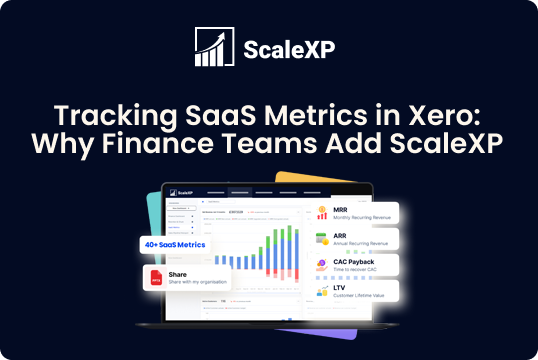
ScaleXP calculates more than thirty SaaS metrics automatically, including ARR, MRR, Net Revenue Retention, CAC, LTV, and cohort retention.
Because these metrics are generated from connected systems, finance teams no longer need to maintain complex spreadsheet models to produce reliable board reporting.
You can explore these capabilities further on the ScaleXP SaaS metrics page.
Real-Time Visibility for Leadership
Once systems are connected, SaaS metrics update automatically as customer activity changes. Leadership teams gain faster visibility into ARR growth, churn trends, expansion revenue, and retention performance.
This allows finance leaders to respond quickly when growth patterns shift and to provide leadership with reliable answers during strategic decision making.
Tracking SaaS Metrics in Xero: The Practical Path Forward
Xero remains a powerful accounting system for SaaS companies. It provides a reliable ledger, strong reporting capabilities, and a flexible ecosystem of integrations.
However, SaaS companies require insights that extend beyond traditional accounting reports.
When SaaS metrics are tracked only through spreadsheet models around Xero, reporting becomes slower and harder to maintain as the business grows.
The practical solution for many companies is not to replace Xero, but to extend it with a platform designed specifically for SaaS reporting and finance automation.
See How ScaleXP Simplifies SaaS Metrics
If your finance team is still tracking ARR, churn, retention, and cohort metrics through spreadsheet models alongside Xero, it may be time to upgrade the reporting layer.
See how ScaleXP helps finance teams track SaaS metrics with more speed and confidence