See how ScaleXP works with Xero, QuickBooks or Zoho Books.
In a 30-minute demo, we’ll show the relevant workflows using example data and discuss how they could apply to your finance process. Complex requirements? Discuss them with us first.
Understand committed MRR, calculate it with your own numbers, see what the published growth benchmarks show, and get practical tips to grow it.

COMMITTED MRR
No benchmark exists for committed MRR.
Companies define committed differently, so even a median would compare different definitions. What is benchmarkable is the rate recurring revenue grows.
2026 benchmark · 1,000+ private B2B SaaS companies
This article will provide
CMRR stands for Committed Monthly Recurring Revenue. It is a forward-looking SaaS metric that combines Monthly Recurring Revenue (MRR) with known changes in subscriptions, bookings and churn.
For businesses who sell annual contracts, CMRR is calculated using annual subscriptions, and this is frequently called CARR or committed annual recurring revenue.
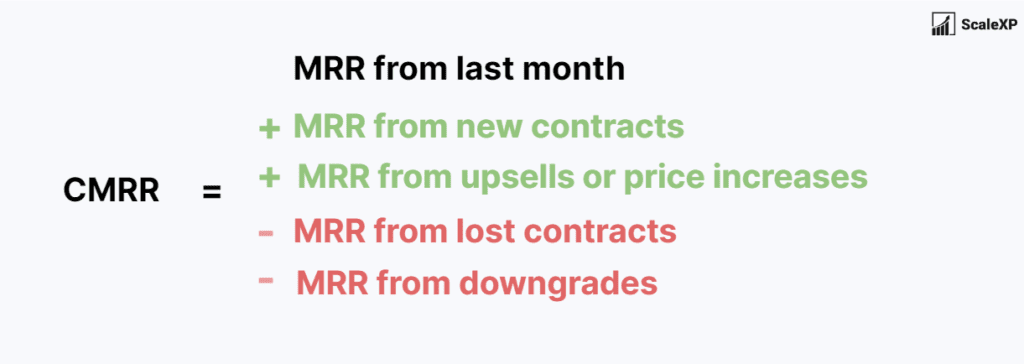
The most common definition of CMRR is prior period MRR, adjusted for all known changes in subscriptions, including new and lost subscriptions as well as upsells or downgrades.
Definitions, formulas, and this year’s median and top-quartile numbers for all 20 metrics in the library. One PDF you can take straight into your next board meeting.
See our privacy policy.
Your report is ready.
Download the 2026 SaaS Benchmark Report We’ve emailed you a copy as well.SaaS companies use CMRR to measure the growth and predictability of their revenue streams. This helps them to make better business decisions, and to plan for future growth.
CMRR is committed monthly recurring revenue while CARR is committed annual recurring revenue. CARR, despite the name, can also be used for quarterly calculations.
A good CMRR depends on the specific business and stage of growth. Rather than assessing absolute CMRR, it is more common to assess the change in CMRR. A CMRR which increases consistently and continuously is positive. The larger the increases in CMRR, the better, as this indicates strong growth in revenue and low churn.
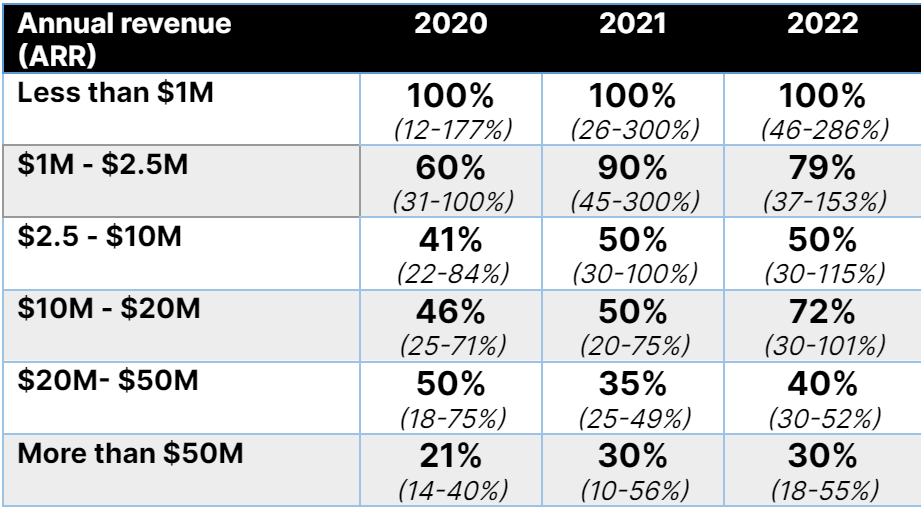
CMRR is not benchmarked as an absolute figure anywhere credible, and it cannot sensibly be: it is a currency amount that scales with the size of the business. The closest usable comparison is the rate at which it grows, measured against 2026 private SaaS growth medians. The figures and a worked bridge follow.
There is no published CMRR benchmark, and that is not an oversight — CMRR is an absolute figure that scales with company size, and firms disagree about what counts as committed. It is still worth benchmarking, just not as a level. Compare the rate it grows at, and present the bridge that produced it.
Monthly growth equivalent to 2026 median annual growth rates.
| Line | Amount | Include only if |
|---|---|---|
| Current MRR | $100,000 | Live and billing today |
| Committed new business | +$6,000 | Contract signed, not yet started |
| Committed expansion | +$2,500 | Upgrade agreed in writing |
| Scheduled churn | −$3,000 | Notice already given |
| Scheduled contraction | −$1,200 | Downgrade already confirmed |
| CMRR | $104,300 | +4.3% on current MRR |
The right-hand column is what keeps CMRR honest. Every line must be already signed, agreed or formally notified. The moment weighted pipeline or expected renewals are allowed in, CMRR stops being a metric and becomes a forecast wearing a metric’s clothes — and it will be treated with the scepticism a forecast deserves.
CMRR has no universal definition and no published industry median, and any source offering one should be treated carefully. Two things make it unbenchmarkable in absolute terms: it is an absolute currency figure, so it scales entirely with company size, and companies draw the line between committed and merely likely in different places. What can be compared is the rate of change — which is why the useful presentation is the bridge above plus the resulting percentage, rather than a number held up against a market average that does not exist.
Sources: growth medians from SaaS Capital’s 2026 private B2B SaaS growth benchmarks, covering more than 1,000 private companies. Monthly figures are compounded equivalents of those annual rates, shown as derived values rather than observed monthly medians. CMRR definition follows ChartMogul’s methodology. No published absolute CMRR benchmark exists.
See what is already committed
MRR shows where the business is today. ScaleXP adds signed new business and expansion, then subtracts confirmed churn and downgrades, to show the recurring revenue already committed for the months ahead.
Keep forecasts out of CMRR: every movement must be signed, agreed or formally notified.
Automate Your SaaS MetricsExample connected CMRR bridge
Current MRR
$100,000
Recurring revenue from subscriptions that are active and billing today.
Illustrative example figures, not your live data.
Read the bridge from the top down. Start with the MRR billing today, add only what is contractually committed, subtract only what has already been notified, and the result is CMRR. The percentage change between the two is the figure worth tracking month to month and comparing against the growth benchmarks above.
ScaleXP fully automates MRR and CMRR. Using a series of smart test recognition algorithms, revenue is split into New, Lost, Upsells and Downgrades. This provides both aggregate numbers and a breakdown of the key drivers.
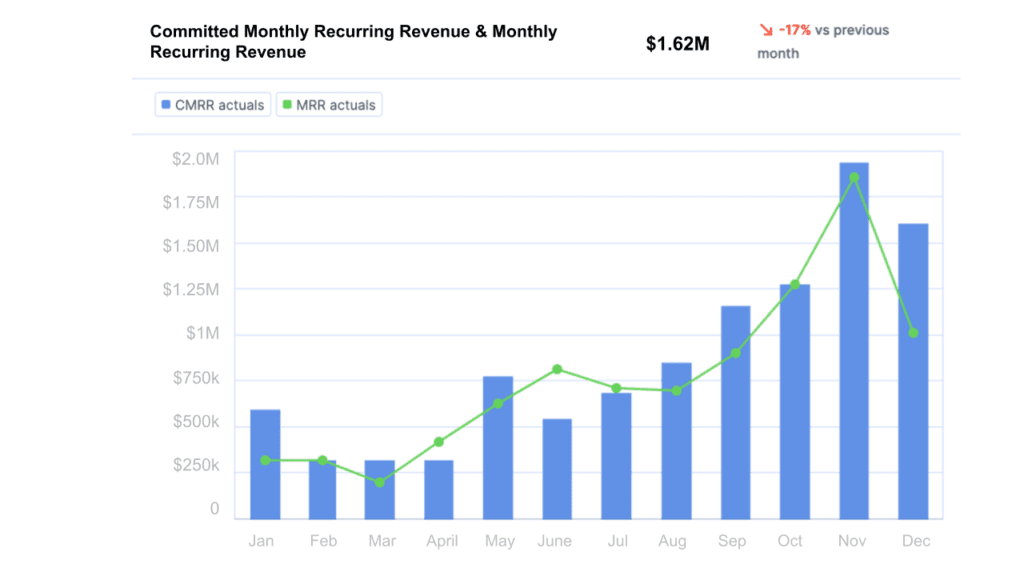
Charts are built to show performance over time, by month, quarter, or year. This data makes it easier for SaaS companies to track performance easily and without the need for detailed spreadsheets.
Boards and investors ask for committed monthly recurring revenue (CMRR) because it shows where recurring revenue is heading, not just where it stands today. CMRR adds signed new business and committed expansion to current MRR, then subtracts scheduled churn and contraction, using only signed contracts or formal notices rather than weighted pipeline. No absolute CMRR benchmark exists, so investors compare growth instead, such as the 22% median annual growth for B2B SaaS. ScaleXP calculates CMRR automatically, so finance can present that forward view with confidence.
Yes, ScaleXP calculates CMRR automatically by combining current MRR from invoices in Xero, QuickBooks or Zoho Books with signed deals, renewals and cancellations from HubSpot, Salesforce or Pipedrive. Committed new business, committed expansion, scheduled churn and scheduled contraction are each classified, so the CMRR bridge builds itself. ScaleXP prepares the metric daily alongside 30+ other SaaS metrics. Finance teams stop maintaining a separate committed-revenue spreadsheet and get a forward-looking recurring revenue figure that stays current.
ScaleXP keeps committed MRR (CMRR) consistent with the general ledger because the starting point, current MRR, is built from invoices and journals in Xero or QuickBooks rather than CRM deal values. Committed changes are then layered on from signed CRM records, and finance controls what counts as committed. ScaleXP also tracks renewals and flags missed invoices, so a signed contract that has not been billed is visible before month-end. The result is a committed monthly recurring revenue figure that ties back to the financials and stands up in front of the board.
ScaleXP shows the CMRR bridge in PowerPoint board packs and live dashboards, moving from current MRR through committed new business, expansion, churn and contraction to committed monthly recurring revenue. Directors see what is contracted, not merely forecast, and in presentation mode they can drill down to the customers behind each movement. ScaleXP also feeds renewals into forecasting from pipeline and renewals, so the board sees how CMRR supports the plan. Finance teams present a clear, defensible forward view of recurring revenue every month.
For Xero, QuickBooks and Zoho Books
ScaleXP connects current recurring revenue with signed contracts, scheduled upgrades and churn already notified. The result is a transparent CMRR bridge finance can explain and the board can trust.
From current MRR to committed revenue
ScaleXP starts with the recurring revenue active in your connected accounting system.
Related metricsmonthly recurring revenueannual recurring revenueMRR growth raterenewal retention rate

Percentage increase in MRR over a certain period of time, most typically a quarter or a year.

Percentage increase in revenue over a certain period of time, most typically a quarter or a year.

Predictable revenue that a company can expect to receive on an annual basis from its subscription-based products or services.
““producing more insights, faster and with greater accuracy”
SaaS metrics
ScaleXP calculates committed MRR and 30+ other SaaS metrics straight from your accounting and CRM data, prepared daily.
In a 30-minute demo, we’ll show the relevant workflows using example data and discuss how they could apply to your finance process. Complex requirements? Discuss them with us first.