Ready to transform data to insight?
Getting started with ScaleXP is easy! Try it for yourself free for 7 days. Or, if you have specific questions, just use the button to the right to schedule a quick meeting.

The Rule of 40 measures the growth and profitability of a subscription business. Across companies of all sizes, a result of 40% or more is positive and indicates strong performance. According to McKinsey,investors reward SaaS companies that are at or above the Rule of 40 with consistently higher valuation multiples.
For a rule of 40 calculation, simply add the company’s annual revenue growth rate and its EBITDA or Operating Profit Margin. The formula is:
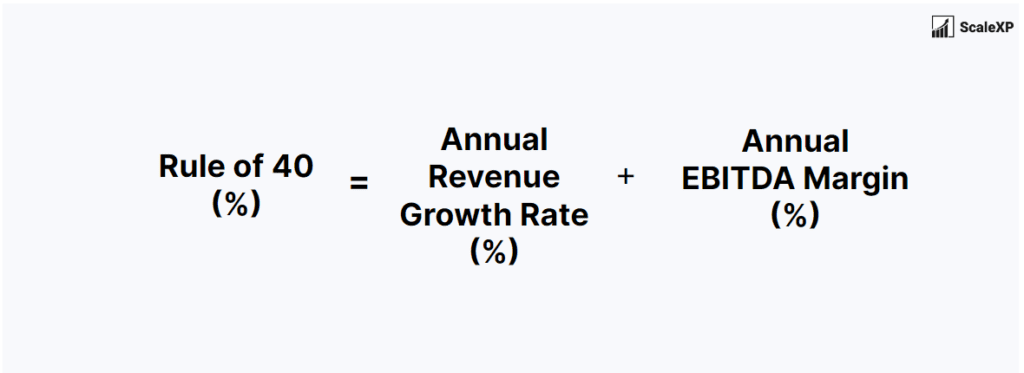
For example, if a company has an annual revenue growth rate of 20% and an EBITDA Margin of 20%, the company’s Rule of 40 would be 40 (20 + 20). 40 or above is viewed as a good result, across companies of all sizes.
For example, take a SaaS company growing annual revenue by 30% with an EBITDA margin of 5%.
Step 1: Annual revenue growth = 30%
Step 2: EBITDA margin = 5%
Step 3: Add the two together:
30% + 5% = 35%
The company’s Rule of 40 score is 35%. This is below the traditional 40% benchmark, although it still reflects a business combining strong growth with positive profitability.

Rule of 40 is commonly used for benchmarking performance. Some investors and analysts also use the Rule of 40 as a factor in valuing companies.
One indication of the Rule of 40’s adoption is the frequency with which it appears in the financial press and industry analysis. For example, Bessemer Venture Partners, a prominent venture capital firm that invests in SaaS companies, has discussed the Rule of 40 in their annual “State of the Cloud” reports.
Finance teams and CFOs often question whether the ‘Annual Revenue Growth Rate’ should be calculated as recurring revenue or total revenue. The choice can be complex, but ultimately comes down to the importance of non-recurring or one-off revenue. When it’s a small percentage of the total, it is typically excluded, whereas if it’s a core part of the offering, it’s included. If you’re still unsure, just track Rule of 40 using both definitions. Monitoring these over time frequently leads to additional insights and clarity as to which option is best.
With Rule of 40, the higher the number, the more favourable the result.This being said, there’s huge variability in top quartile results by company size.
A Rule of 40 score of 40% or more remains a strong benchmark for SaaS companies in 2026, showing a healthy balance between growth and profitability.
Current benchmarks vary by company size, maturity and SaaS segment. Q1 2026 vertical SaaS data puts median Rule of 40 performance at approximately 23–26%, while top-quartile performance is above 40%.
This means a company does not necessarily need to reach 40% to be performing in line with its peers. However, reaching or exceeding 40% remains a useful indicator of strong growth and profitability combined.
When benchmarking your company, compare your Rule of 40 against businesses at a similar stage and size, and track the metric consistently over time.
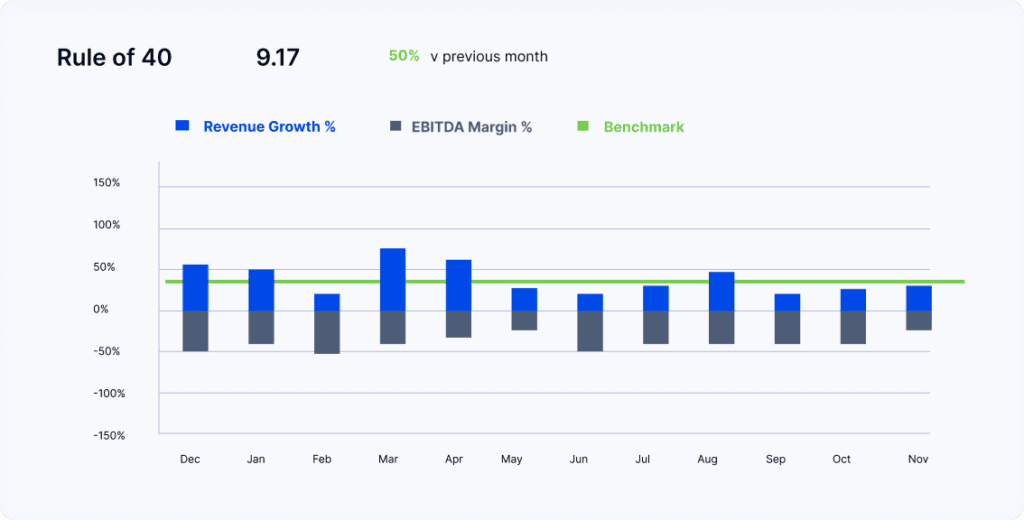
ScaleXP automates Rule of 40 calculations. Through integrations with both your accounting and CRM systems, as well as a smart set of text recognition algorithms, the system provides a fully automated view of all metrics. Graphs, such as the one shown, are interactive, allowing you to easily see detailed data in a few clicks.
nHowever the “Rule of 40” is just one of several important metrics automated by the ScaleXP platform. To read more about how the system can automate all your SaaS metrics, click here. Or, if you would like to dive right in and take a look for yourself, you can start a free 7-day trial here.
If you found this metric guide or any of our other SaaS metric pages helpful, we invite you to book a free demo of our platform and take your business to the next level.

Percentage increase in revenue over a certain period of time, most typically a quarter or a year.

A measure of growth or sales efficiency. Calculated as Revenue Growth divided by Customer Acquisition Costs.

Measures growth in revenue from a group of customers. Typically split into upgrades, downgrades, renewals and losses.
Connect and combine data from a wide range of accounting & sales CRM systems. Use integrated data to create a comprehensive, fully automated suite of SaaS metrics.
Click below to understand if ScaleXP connects to your systems.

A score of 40% or higher is generally considered strong. However, benchmarks vary significantly depending on company size, maturity and market conditions.
In 2026 vertical SaaS benchmark data, median performance is around 23–26%, while top-quartile companies exceed 40%.
Add your annual revenue growth rate to your chosen profitability margin, typically EBITDA or operating profit margin.
For example, a SaaS company with 30% annual revenue growth and a 10% profit margin has a Rule of 40 score of 40%.
es. The Rule of 40 remains a useful way to assess the balance between SaaS growth and profitability, particularly for investors, boards and finance teams.
The market context has evolved, with greater emphasis on efficient and profitable growth. Rule of 40 should therefore be considered alongside metrics such as ARR growth, NRR, gross margin and cash generation rather than used as a standalone measure.
Getting started with ScaleXP is easy! Try it for yourself free for 7 days. Or, if you have specific questions, just use the button to the right to schedule a quick meeting.