
See how ScaleXP works with Xero or QuickBooks.
In a 15- or 30-minute demo, we’ll show the relevant workflows using example data and discuss how they could apply to your finance process. Complex requirements? Discuss them with us first.
How auditors test deferred revenue: the rollforward, recalculation, contract inspection, cut-off and analytics, plus the evidence finance should prepare.
Key takeaways
Short answer: Auditors test deferred revenue by rolling the balance forward from the prior year, recalculating the release for a sample of contracts, inspecting the contracts and invoices behind those balances, testing cut-off around the year-end, and comparing the results with their own expectations. Finance teams that keep a customer-level schedule tied to the ledger each month, with the source documents indexed to it, usually get through this work with fewer questions.
The exact procedures depend on the audit firm, the risk assessment and the size of the balance. The approach described here is general, but it reflects the evidence most auditors ask SaaS and subscription companies to provide.
The table summarizes the main deferred revenue procedures and the evidence that supports each one. Each procedure is described in more detail below.
| Procedure | What the auditor tests | What to prepare |
|---|---|---|
| Rollforward | Opening balance, billings and revenue recognized explain the closing balance | Annual rollforward tied to the ledger, with each reconciling item explained |
| Recalculation | The release for sampled contracts follows the stated policy | Customer-level schedule with contract value, service dates, amount released and remaining balance |
| Contract inspection | The schedule matches signed terms, amendments and invoices | Contracts, amendments and invoices for the largest customers, indexed to the schedule |
| Cut-off | Invoices and credit notes around the year-end sit in the right period | List of invoices and credit notes around the year-end, with service periods |
| Journal review | Manual entries to deferred revenue are supported and approved | List of manual journals to deferred revenue, with the reason and approver for each |
| Analytics | Movements in the balance match changes in the business | A short explanation for each significant movement against the prior year |
Deferred revenue sits between billings and recognized revenue, so an error in the balance is usually an error in revenue as well. If a release is calculated over the wrong period, revenue for the year is overstated or understated by the same amount the liability is misstated.
Revenue is commonly treated as a higher-risk area in an audit, and for SaaS companies that bill in advance, deferred revenue is where most of the judgment and calculation sits. The work is guided by the company's policy under ASC 606 in the US or IFRS 15 internationally, so the first thing an auditor reads is the written revenue recognition policy. Our ASC 606 audit checklist for SaaS CFOs covers the policy side in more detail.
The rollforward is normally the first schedule an auditor requests, because it connects the prior-year audited balance to the current-year balance. It shows:
The auditor then agrees the closing balance to the customer-level schedule. If the schedule total and the ledger differ, the difference has to be explained before testing goes further. Reconciling items that are unexplained or labeled only as "adjustment" draw attention quickly. Our article on why deferred revenue reconciliation breaks covers how those differences arise.
Recalculation tests whether the schedule applies the policy correctly. The auditor selects a sample of contracts, takes the contract value and service period from the source documents, and recomputes the revenue that should have been recognized and the balance that should remain.
Illustrative example: a 12-month subscription worth $36,000 starts on March 1, 2026, invoiced in full on that date. On a straight-line monthly basis, $3,000 is recognized each month. At December 31, 2026, the auditor expects $30,000 recognized and $6,000 remaining in deferred revenue.
The table below shows what the auditor compares for that contract.
| Item | Auditor's recalculation | Company schedule | Difference |
|---|---|---|---|
| Revenue recognized in 2026 | $30,000 | $30,000 | $0 |
| Deferred revenue at December 31, 2026 | $6,000 | $6,000 | $0 |
Source: illustrative figures prepared for this article, not outside data.
Differences often come from the proration convention. A schedule that releases by day gives slightly different monthly figures from one that releases by whole month. Either can be acceptable if the policy states it and the schedule applies it consistently.
Contract inspection checks that the schedule reflects the agreed terms. For each sampled item, the auditor typically compares the schedule with:
Auditors may also select items in the other direction: they start from a contract or invoice and check that it appears in the schedule. This tests completeness, the risk that some billings did not reach deferred revenue.
Cut-off testing checks that billings, credit notes and revenue are recorded in the correct period. Auditors select invoices and credit notes raised in the days before and after the year-end and confirm the service period and posting date.
Typical cut-off issues in SaaS businesses include renewal invoices raised in December for a term starting in January, credit notes for cancellations issued after year-end that relate to the prior year, and invoices with no service dates that were recognized in full when raised.
Analytical procedures compare the balance with an expectation the auditor builds independently. Common approaches include:
Analytics rarely replace tests of detail on a material balance, but they direct the auditor's attention, and a clear explanation for each significant movement saves time.
A prepared-by-client list for deferred revenue usually includes the following. Having it ready at the start of fieldwork is the most effective way to shorten the audit.
The approval trail matters as much as the numbers. Our article on what auditors accept as an audit trail explains what reviewers look for when journals are prepared by software.
The same findings appear repeatedly in deferred revenue testing. Most are process issues rather than policy disagreements.
ScaleXP builds month-by-month deferred revenue schedules from invoices in Xero or QuickBooks, by customer, product and contract. Service dates can come from the invoice or from CRM data in HubSpot, Salesforce or Pipedrive, and schedules with missing dates, unusual billing terms or amendments are flagged for finance review. When an invoice changes, the schedule is recalculated.
In the ScaleXP demo company below, the deferred revenue journal shows for each month how invoiced revenue is deferred to the balance sheet, released as invoices reach their recognition months, and adjusted for accrued revenue.
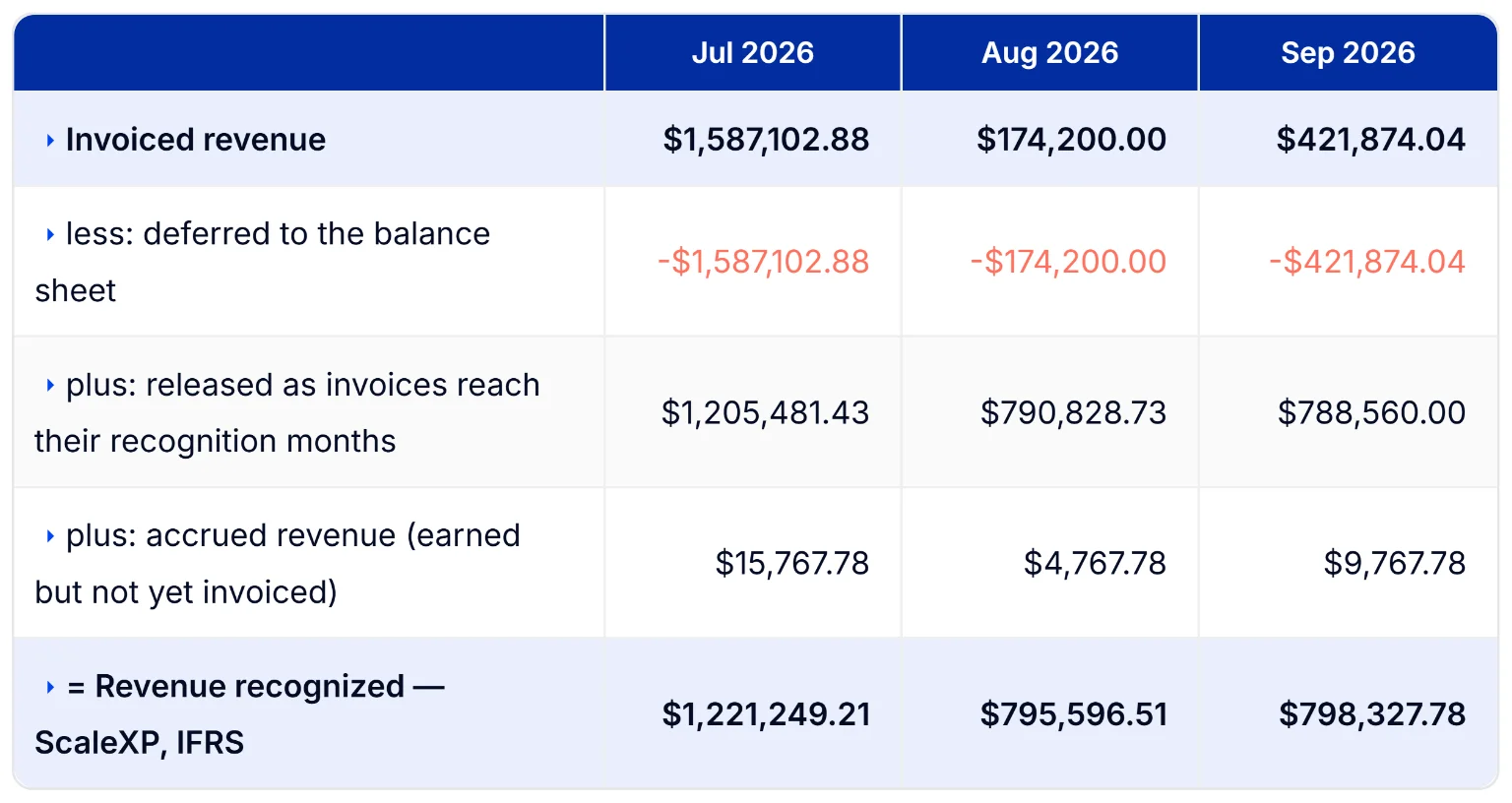
ScaleXP prepares the deferred revenue and recognized revenue journals, and they are posted once finance approves them. Opening, movement and closing balances reconcile to the journals in the ledger, and each figure drills down to its source invoice, which is the evidence auditors sample. Every journal includes a full audit trail, downloadable as a spreadsheet, and auditors can have read-only access. Read more about deferred revenue schedules and journals in ScaleXP.
Auditors test deferred revenue through a rollforward, recalculation, contract and invoice inspection, cut-off testing and analytics. Each procedure is easier to support when the customer-level schedule ties to the ledger every month, service dates come from the source documents, and every adjustment has a reason and an approver.
Auditors usually ask for the revenue recognition policy, an annual rollforward of deferred revenue tied to the ledger, and a customer-level schedule at year-end. They then request contracts, amendments and invoices for a sample of customers, plus invoices and credit notes around the year-end for cut-off testing. A list of manual journals to deferred revenue, with approvers, is also commonly requested.
It is a reconciliation from the opening balance, agreed to the prior-year audited figure, to the closing balance in the ledger. It adds invoices for future service, subtracts revenue recognized and adjusts for credit notes and cancellations. Auditors use it to confirm that the movements in the year explain the change in the balance, before they test individual contracts.
They select invoices and credit notes recorded shortly before and after the year-end and check the service period, posting date and amount against the source documents. The aim is to confirm that revenue and deferred revenue are recorded in the correct period. Renewal invoices raised before a new term starts and late credit notes are common areas of focus.
Both conventions are used in practice. Releasing by day spreads revenue in proportion to the days in each month, while releasing by month recognizes an equal amount each full month. The company's policy should state which convention applies, and the schedule should apply it consistently, because auditors recalculate sampled contracts using the stated method.
Common adjustments relate to invoices without service dates, contract amendments that were not reflected in the schedule, and manual journals to deferred revenue without supporting documents. Differences between the schedule total and the ledger balance that were carried forward from earlier periods also lead to adjustments. Most of these are prevented by reconciling the schedule to the ledger every month.
Sources (checked October 2026): IFRS Foundation, IFRS 15 Revenue from Contracts with Customers.
How ScaleXP does this
ScaleXP calculates deferred revenue from your invoices and contracts and keeps the balance sheet reconciled every month. See ScaleXP’s deferred revenue automation
Close-time estimator
Your accounting system
How long does your close take today? Working days, roughly
Which of these do you still do manually? Select all that apply
Which of these takes the most time? Pick one
Your estimate
Your 3–5 day Xero or QuickBooks close could be closer to 2.5 days
Deferred revenue is where you would feel it first. ScaleXP prepares the schedules and journals for each task you selected from your live Xero or QuickBooks data. What stays with your team is the review and the posting decision.
Cue Technology saves 3–5 finance-team days a month. Xero customer