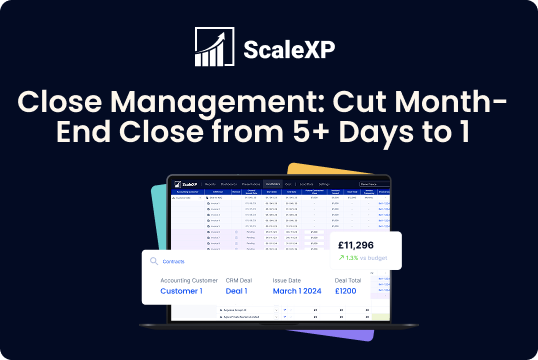


Most finance teams spend at least five days closing the books every month. Some take seven. A few take ten. The problem isn't laziness or incompetence—it's that month-end close has been built on manual processes that simply don't scale.
The cost isn't just time. It's opportunity cost. Senior finance talent that should be analyzing trends, refining forecasts, and advising leadership is instead chasing missing invoices, manually calculating accruals, and reconciling spreadsheets. Strategic work gets pushed to the side because the mechanics consume everything.
Close management—the structured discipline of planning, sequencing, and automating month-end tasks—changes this. Finance teams that implement proper close management consistently finish in under a day whilst maintaining accuracy and audit readiness. This article shows you how.
Key Takeaways
- Manual close processes often take 5-10 days because finance tasks are sequential and spreadsheet-heavy
- Close management means planning, sequencing, automating, and reviewing month-end tasks consistently
- The biggest bottlenecks are revenue recognition, accruals, prepayments, reconciliations, and management reporting
- ScaleXP automates close calculations while keeping finance teams in control of review and posting
- A one-day close is achievable when journals, reconciliations, and reporting are prepared automatically
- Finance teams regain time for analysis, forecasting, and board-level insight instead of manual processing
Why Finance Teams Are Still Spending 5, 7, Even 10 Days on Close
The extended close isn't a reflection of team capability. It's structural. Most finance systems were designed for compliance, not speed. They record transactions but don't automate the judgments and calculations required at month-end.
The result is a sequential bottleneck. Revenue recognition entries must be calculated manually before you can run management accounts. Accruals must be estimated before you can close AP. Prepayments must be identified and spread before the P&L is accurate. Each task waits for the previous one to finish.
Meanwhile, finance teams are caught in a cycle of data entry and checking. Qualified accountants—people capable of deep financial analysis—are spending their time on tasks that could be automated. The business is growing, but the close process stays manual, and every month takes longer than the last.
This isn't an edge case. It's the norm. Most businesses running on Xero or QuickBooks hit this wall around £2-5 million in revenue. The accounting software handles transactions well, but it doesn't handle the complexity that comes with growth: multi-period contracts, deferred revenue, accrued revenue, prepayments, and management reporting across multiple entities or segments.
The opportunity cost is significant. Every day spent on close mechanics is a day not spent on budgeting, variance analysis, cash flow forecasting, or strategic planning. The CFO becomes a bookkeeper by necessity, and the board gets its pack a week late every month.
What Close Management Actually Means And What It Isn't
Close management is the process of planning, sequencing, automating, and reviewing month-end tasks to consistently achieve a fast, accurate, audit-ready close. It's a discipline, not a motivational speech.
It is not working harder, staying later, or hiring more people. It is not rushing through reconciliations and hoping for the best. It is redesigning the close around automation so the finance team spends time on what only humans can do: judgment, interpretation, and strategic insight.
Why does this matter? Businesses that treat close management as a discipline consistently outperform those that treat it as an unavoidable burden. They make better decisions because they have timely data. They catch issues earlier because they have capacity to analyze. They attract and retain better finance talent because the work is strategic, not administrative.
The shift requires a mindset change. The question stops being "how do we get through this month's close?" and becomes "how do we design a close process that works every month with minimal manual effort?" That's the difference between operational firefighting and operational excellence.
The Bottlenecks That Add Days to Every Close
Let's be specific about what actually takes the time. Most finance teams recognize these immediately:
Revenue recognition entries: calculating which invoices relate to which periods, identifying multi-period contracts, calculating deferred revenue, and creating the journals manually every month. For SaaS businesses or any company with annual contracts, this alone can take 1-2 days.
Accruals: hunting for missing supplier bills that relate to the prior month, estimating amounts based on patterns or contracts, and creating accrual journals by hand. This requires cross-referencing emails, checking contracts, and making judgment calls on what's likely to arrive.
Prepayments: identifying which bills span multiple periods—insurance, software subscriptions, rent—and calculating the correct split between current and future months. Each one requires a separate journal entry with full supporting documentation.
Reconciliations: checking every line in the nominal ledger against the bank statement, the AR ledger, the deferred revenue schedule, and the fixed asset register. Any discrepancy requires investigation, which means tracking down source documents and transactions from weeks earlier.
Management reporting: pulling data from the accounting system, adjusting for period-end entries, formatting in spreadsheets, adding commentary, and waiting for sign-off. If you're reporting across multiple entities or segments, multiply the effort by each reporting unit.
Each of these tasks is sequential. You can't finalize management accounts until revenue recognition is complete. You can't close the period until reconciliations are done. That's why five days becomes seven, and seven becomes ten. One bottleneck delays everything downstream.
How ScaleXP Removes Every One of Those Bottlenecks
ScaleXP automates the calculations that consume days of manual effort. It connects directly to Xero and QuickBooks, reads all transactions, and applies the logic required for month-end entries.
Revenue recognition bottleneck: ScaleXP's AI reads every invoice in Xero and QuickBooks to identify relevant recognition periods. It calculates the deferred revenue balance and the monthly recognition journal automatically. The journal comes with full audit trail detail—contract start date, end date, recognition period, amounts—so the finance team can review in minutes and post in two clicks.
Accruals bottleneck: ScaleXP uses pattern recognition to identify missing supplier bills based on historical patterns and contract data. It proposes accrual amounts for review. The finance team confirms or adjusts, then posts. No manual hunting through emails or estimating from memory.
Prepayments bottleneck: ScaleXP reads all bills in Xero and QuickBooks, identifies those spanning multiple periods, and calculates the correct prepayment journal. Full audit trail detail is provided—bill date, service period, amount allocated to each month—ready for review and posting in two clicks.
Reconciliation bottleneck: ScaleXP presents reconciliations in easy-to-understand schedules. Discrepancies are surfaced automatically with links to source transactions. Once confirmed, journals are prepared in seconds with full audit trail detail. No more manual line-by-line checking.
Reporting bottleneck: Live management accounts and board packs are generated automatically from the same underlying data. P&L, balance sheet, cash flow, and business metrics update in real time as entries are posted. No more spreadsheet reformatting.
Accrued revenue bottleneck: For businesses that recognize revenue before invoicing, ScaleXP calculates accrued revenue journals automatically. Full audit trail detail makes it easy to check and post in two clicks.
Xero Tracking Codes and QuickBooks Class and Location: ScaleXP integrates these automatically, so revenue and expenses are allocated correctly without manual intervention. No more end-of-month reallocation journals.
Complex revenue recognition: Multiple contract types, usage-based billing, discounts, and renewals are all handled. ScaleXP applies IFRS 15 and ASC 606 logic automatically, with full documentation for auditors.
Business metrics: Customer growth, retention, churn, MRR, ARR, LTV, and CAC are updated automatically from the same transaction data. No separate spreadsheet models to maintain.
Nothing posts without finance team approval. You retain full control at every step—ScaleXP handles the calculations, you confirm the logic and post. ScaleXP customers reduce close time by 75-90%, from five or more days to under a day.
What a 1-Day Close Looks Like in Practice
Picture this: it's the morning of day one of the new month. You open ScaleXP and all revenue recognition, prepayment, accrual, and accrued revenue journals have already been calculated overnight based on last month's data.
You review the proposed entries. Each one shows the full calculation logic, source transactions, and audit trail. You spot-check a few against the underlying invoices and bills. Everything ties. You click approve, and the journals post to Xero or QuickBooks in seconds.
Next, you open the reconciliation schedules. ScaleXP has matched transactions automatically and surfaced the exceptions—two unreconciled payments and one timing difference. You investigate, confirm the treatment, and approve the reconciling journals. Done in ten minutes.
Management accounts are already generated. P&L, balance sheet, and cash flow are ready from live data. You review the numbers, add commentary on variances, and export. The board pack is drafted with metrics, KPIs, and supporting detail ready for final review by mid-morning.
By lunchtime on day one, the close is complete, the board pack is ready, and the finance team is available for analysis. You can spend the afternoon on variance analysis, updating forecasts, or working on next quarter's budget.
Compare that to the old way: five, seven, or ten days of sequential manual effort. Revenue recognition taking two days because you're calculating everything in spreadsheets. Accruals taking a day because you're hunting through emails. Reconciliations taking another day because you're checking every line manually. Management reporting taking two more days because you're pulling data from multiple sources and reformatting.
The difference isn't marginal. It's transformational. A one-day close gives you four to nine extra days every month to do the work that actually moves the business forward.
Is a 1-Day Close Realistic for Your Business Right Now?
If you're already using Xero or QuickBooks, ScaleXP connects directly—no migration required. You keep your existing accounting system and add the automation layer on top.
If you have complex revenue recognition, multiple entities, or fast growth, you'll see the highest benefit. These are precisely the scenarios where manual processes break down and consume the most time. ScaleXP is built for complexity.
If you have very simple revenue and a tiny team, you may achieve a fast close without automation. But you'll hit a ceiling as you grow. The question is whether to implement close management practices now or wait until the pain becomes unbearable.
The honest answer: most businesses spending five or more days on close are ready for automation now. The technology exists, it integrates with your current systems, and the ROI is immediate. Your finance team gets their time back, the business gets timely data, and the board gets its pack on schedule.
The question isn't whether to automate eventually—it's how much longer to wait. Every month you delay is another month of senior finance talent consumed by mechanics instead of strategy. Another month of late board packs and delayed decisions. Another month where the finance team is underwater instead of leading.
Book a free demo → and see how ScaleXP automates your specific close process. You'll walk away with a clear plan for cutting your close time by at least 75%.