

See how ScaleXP works with Xero, QuickBooks or Zoho Books.
In a 30-minute demo, we’ll show the relevant workflows using example data and discuss how they could apply to your finance process. Complex requirements? Discuss them with us first.
Updated 2026 SaaS ARR and revenue valuation multiples. See public and private SaaS benchmarks, Rule of 40 impact, NRR, growth and investor-ready SaaS metrics.
Last updated August 2026.
SaaS valuation multiples in 2026 are more selective than they were during the growth-at-all-costs market.
ARR still matters. But investors are now looking more closely at growth quality, retention, profitability, AI defensibility and capital efficiency.
For SaaS CFOs and finance leaders, the message is clear:
This article summarizes the latest 2026 SaaS valuation benchmarks and explains which metrics finance teams should track before a fundraise, board meeting or exit process
| 2026 takeaway | What it means for SaaS finance teams |
|---|---|
| Public SaaS multiples remain below pandemic-era levels | Do not assume 2021-style ARR multiples in fundraising or exit planning. |
| The market is more selective | Premium multiples are reserved for companies with stronger growth, retention and margins. |
| Rule of 40 matters again | Growth is being assessed alongside profitability and free cash flow. |
| NRR is a valuation lever | Strong expansion and low churn support higher revenue quality. |
| AI risk is affecting software valuations | Investors are reassessing product defensibility and long-term software moats. |
| Metrics quality matters | Investors need reliable ARR, revenue, churn and cohort reporting. |
Current public benchmarks show the scale of the reset. The BVP Nasdaq Emerging Cloud Indexcurrently shows an average revenue multiple around 6.2x and average revenue growth around 19.4%.
At the same time, SaaS Capital’s 2026 trends reportnotes that SaaS valuations hit decade-plus lows in Q1 2026 as markets priced in AI as a potential threat to traditional software models.
Valuation multiples are market-driven, but valuation readiness is finance-driven. SaaS finance teams need ARR, NRR, GRR, recognized revenue and deferred revenue to reconcile back to source data before board meetings, fundraising or exit diligence.
Investors price ARR on the metrics underneath it. The free 2026 SaaS Metrics Benchmark Report sets 20 SaaS metrics, including gross margin, Rule of 40, CAC payback and LTV:CAC, against published 2026 benchmarks. It gives the source and date for every figure. 48 pages, PDF.
See our privacy policy.
Your report is ready.
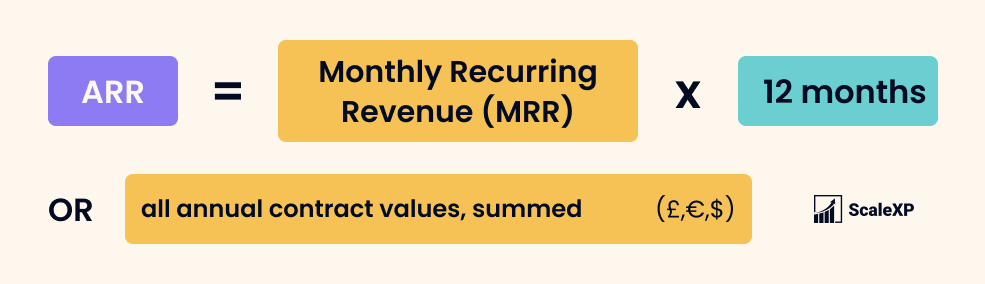
Download the 2026 SaaS Benchmark Report →We’ve emailed you a copy as well.An ARR valuation multiple compares a SaaS company’s valuation with its annual recurring revenue.
| Example company | ARR | Valuation | ARR multiple |
|---|---|---|---|
| SaaS Company A | $10m | $50m | 5.0x ARR |
| SaaS Company B | $10m | $100m | 10.0x ARR |
ARR multiples are commonly used for SaaS companies because recurring revenue is one of the clearest indicators of future revenue visibility.
However, not all ARR is valued equally. Investors will usually apply a higher multiple to ARR that is growing quickly, retained well, generated efficiently and supported by strong margins.
For finance teams, this makes ARR reporting a board-level control issue. ARR should be traceable, explainable and consistent with customer, invoice and revenue data.
ScaleXP helps SaaS finance teams track ARR, MRR and revenue movement through finance-controlled reporting.
ARR multiples and revenue multiples are often discussed together, but they are not always the same.
| Metric | What it uses | Common use |
|---|---|---|
| ARR multiple | Annual recurring revenue | SaaS fundraising, private SaaS valuation and subscription software benchmarks |
| Revenue multiple | Total revenue, run-rate revenue, LTM revenue or forward revenue | Public market comparisons, M&A benchmarks and broader software valuation |
| EV/revenue multiple | Enterprise value divided by revenue | Public company and M&A analysis |
| Market cap / ARR | Market value divided by annualized recurring revenue | Public SaaS index and ARR benchmark analysis |
When comparing SaaS valuation multiples, always check the definition. A 6x forward revenue multiple is not the same as a 6x ARR multiple based on current run-rate ARR.
The SaaS Capital Index calculates its ARR multiple as market capitalization divided by annualized current run-rate revenue.
There is no single SaaS valuation multiple in 2026. The market is split by growth rate, company size, retention, profitability, product category and investor confidence.
| Benchmark | 2026 reference point |
|---|---|
| BVP Nasdaq Emerging Cloud Index | Around 6.2x average revenue multiple |
| Meritech median public software | 3.2x median implied ARR multiple |
| Meritech top 10 public software companies | 11.7x median implied ARR multiple |
| Aventis Rule of 40 SaaS analysis | 3.6x median EV/revenue multiple |
| Finerva / SEG B2B SaaS benchmark | 5.9x B2B SaaS revenue multiple |
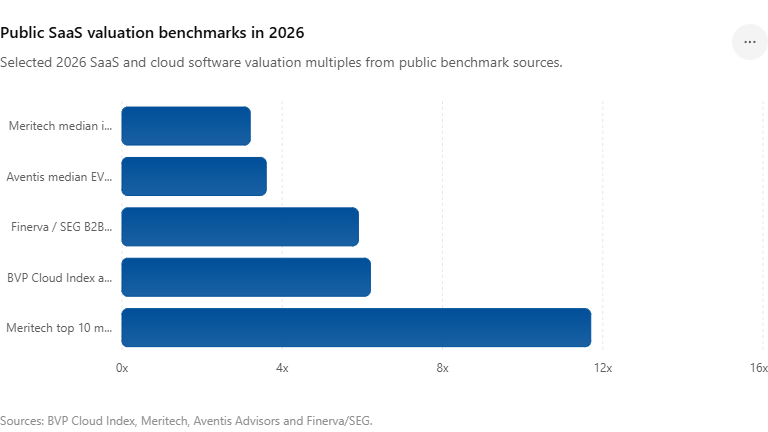
Current public SaaS benchmarks show a broad range:The important point is not the exact median on any single day. Public multiples move constantly.
The more useful question for finance leaders is: What makes one SaaS company deserve a higher ARR or revenue multiple than another?
SaaS valuations in 2026 reflect a different investor mindset.
During 2020 and 2021, high growth and recurring revenue often attracted premium multiples, even where profitability was distant. By 2026, the market is more cautious. Growth still matters, but investors are asking harder questions about quality, efficiency and durability.
SaaS growth rates have normalized from the pandemic-era peak.
For many private SaaS companies, growth is now more moderate. SaaS Capital’s 2026 private B2B SaaS benchmark shows median revenue growth of 15% for bootstrapped SaaS companies with $3m to $20m ARR.
That does not mean growth is unimportant. It means investors are more focused on whether growth is efficient, repeatable and supported by retention.
AI has created both opportunity and risk for SaaS companies.
Some companies are being rewarded for AI-native workflows or clear AI leverage. Others are being discounted where investors fear product commoditization, weaker pricing power or disruption to traditional seat-based software models.
For CFOs, this increases the need to show clear evidence of durable customer value through retention, expansion, usage, gross margin and revenue quality.
Rule of 40 has become a more visible valuation filter again.
A company growing at 40% with negative margins may be assessed very differently from a company growing at 20% with strong free cash flow. Investors want to understand both growth and the cost of achieving that growth.
A company with high ARR but weak retention will often receive a lower multiple than a company with the same ARR and stronger net revenue retention.
NRR and GRR help investors understand whether revenue is durable, expandable and less dependent on constant new customer acquisition.
Investors are spending more time testing whether reported metrics tell a consistent story.
They will not only ask whether ARR is growing. They will ask how that ARR moves by customer, how much is retained, how much is expanding, and how it connects to invoicing, revenue recognition and cash collection.
This makes valuation readiness a finance operating discipline, not just a fundraising exercise.
Public SaaS companies provide the most visible benchmark for valuation multiples, but they are not a perfect proxy for private companies.
Public multiples are affected by stock market sentiment, interest rates, AI expectations, revenue growth, free cash flow, product category and company-specific performance.
As of 2026, public SaaS data shows three clear patterns.
The public SaaS market remains well below the valuation environment seen during the 2020–2021 peak.
Finance leaders should be cautious about using old fundraising decks or 2021 valuation benchmarks when planning a 2026 raise or exit.
The gap between top-performing software companies and average software companies is wide.
Meritech’s 9 April 2026 Software Pulse reported a 3.2x overall median implied ARR multiple for public software, while the top 10 companies had a median implied ARR multiple of 11.7x.
This is a clear reminder that “SaaS company” is no longer enough to earn a premium multiple. The strongest companies are separating from the median.
Median public SaaS multiples are much lower than top-quartile multiples.
That means private companies should avoid anchoring valuation expectations to the best public software companies unless their own metrics are genuinely comparable.
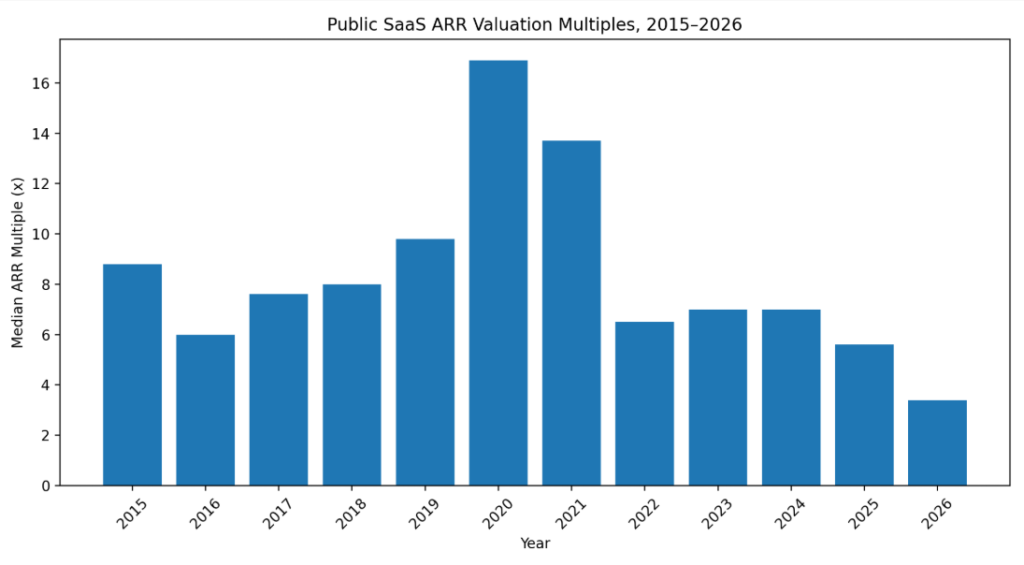
Private SaaS valuations are harder to benchmark because funding rounds and M&A transactions are not always public (see 2026 SaaS benchmarks for ARR growth and funding).
For private companies, ARR multiples usually depend on:
A private SaaS company with $5m ARR, 35% growth, strong NRR and breakeven margins may command a very different multiple from a company with the same ARR but flat growth, weak retention and messy revenue data.
The Finerva B2B SaaS 2026 valuation multiples report reports that B2B SaaS revenue multiples recovered to 6.7x in 2024, then contracted to 5.9x in 2025.
This is why finance teams should prepare more than one benchmark. Use public SaaS indices for context, private SaaS benchmarks for peer comparison (such as CAC payback benchmarks by ARR band), and company-specific metrics to support the valuation story.
SaaS valuation is not driven by ARR alone. The highest-quality ARR usually has five characteristics:
| Valuation driver | Why it matters | Metrics to track |
|---|---|---|
| ARR growth | Shows market demand and revenue momentum | ARR, new ARR, expansion ARR |
| Net revenue retention | Shows whether customers expand or contract | NRR, expansion, contraction, churn |
| Gross revenue retention | Shows durability before upsell | GRR, logo churn, revenue churn |
| Gross margin | Shows scalability of the business model | Revenue, COGS, gross margin by customer/product |
| Rule of 40 | Balances growth and profitability | Revenue growth plus EBITDA or FCF margin |
| CAC payback | Shows sales efficiency | CAC, new ARR, gross margin-adjusted payback |
| Revenue quality | Reduces diligence risk | Recognized revenue, deferred revenue, accrued revenue |
| Forecast visibility | Supports investor confidence | Forecast ARR, renewals, pipeline, bookings |
| Customer concentration | Shows dependency risk | ARR by customer, top 10 customer concentration |
| Reporting confidence | Shows whether management can explain the numbers under review | Reconciled ARR movements, board pack metrics, source-system checks |
Rule of 40 is a simple measure used by investors to assess the balance between growth and profitability.
The formula is:
Revenue growth rate + profit margin = Rule of 40 score
Profit margin may be measured using EBITDA margin, operating margin or free cash flow margin, depending on the investor or benchmark.
For example:
| Revenue growth | EBITDA margin | Rule of 40 score |
|---|---|---|
| 30% | 10% | 40% |
| 20% | 20% | 40% |
| 50% | -10% | 40% |
| 15% | 5% | 20% |
A company above 40% is generally considered to have a healthier balance of growth and profitability. A company below 40% may still be attractive, but investors will look more closely at the reason.
In 2026, Rule of 40 is especially important because many SaaS companies are growing more slowly than they did during the pandemic-era software boom. That makes margin, efficiency and cash generation more important parts of the valuation story.
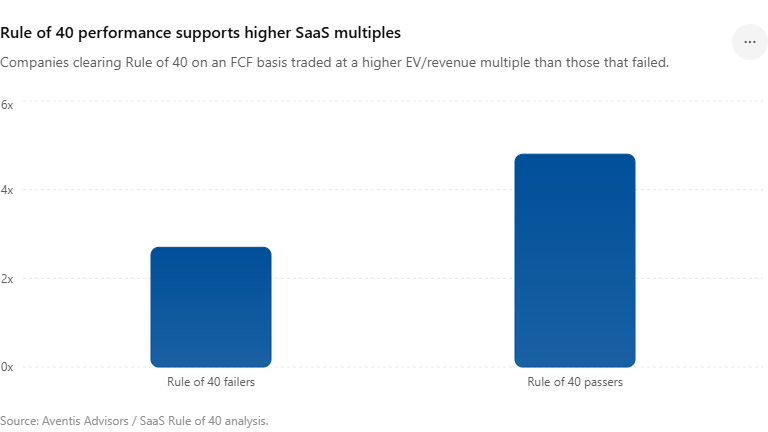
Aventis Advisors’ 2026 Rule of 40 analysis reports that only 8 of 55 listed SaaS companies, or 15%, cleared the Rule of 40 on an EBITDA basis. The same analysis reported a mean EV/revenue multiple of 4.7x and a median EV/revenue multiple of 3.6x.
Net revenue retention is one of the most important SaaS valuation metrics.
NRR measures how revenue from existing customers changes after expansion, contraction and churn.
A company with high NRR can grow even before adding new customers. That is attractive because it shows that the existing customer base is expanding and that the product has continued value.
| NRR result | What it suggests |
|---|---|
| Below 100% | Existing customer revenue is shrinking |
| Around 100% | Expansion offsets contraction and churn |
| Above 110% | Existing customers are expanding meaningfully |
| Above 120% | Strong expansion motion, often seen in higher-quality SaaS companies |
NRR should not be viewed in isolation. A company can have strong NRR but weak gross revenue retention if upsell hides churn. Investors will usually review both NRR and GRR.
ScaleXP helps finance teams track retention, expansion and churn from source data.
Gross revenue retention measures how much recurring revenue is retained before expansion.
It answers a different question from NRR:
A company with high NRR but low GRR may still have a churn problem. A company with strong GRR has a more durable base of recurring revenue.
For valuation purposes, strong GRR reduces perceived risk. It shows that revenue is less dependent on replacing lost customers or constantly finding expansion revenue.
Revenue recognition is often overlooked in SaaS valuation discussions.
That is a mistake.
ARR and revenue are not the same thing. A SaaS company may invoice annually, recognize revenue monthly and carry a deferred revenue balance on the balance sheet. If those movements are not clear, the financial statements can appear disconnected from commercial performance.
Before a fundraise or exit process, finance teams should be able to explain:
Clean revenue recognition does not automatically increase a valuation multiple. But it does reduce friction during diligence by making the link between contracts, invoices, revenue and reported SaaS metrics easier to explain.
ScaleXP helps finance teams automate revenue schedules, recognized revenue, deferred revenue and revenue journals. Learn more about ScaleXP’s revenue recognition software.
Deferred revenue is an important part of SaaS valuation readiness because it explains the gap between invoicing, cash collection and recognized revenue.
Many SaaS companies invoice annually or upfront. That creates cash, but it does not mean all revenue can be recognized immediately. The unrecognized portion is carried as deferred revenue.
Investors may review deferred revenue to understand:
Finance teams should be able to reconcile deferred revenue to invoices, customer contracts and recognized revenue. This becomes especially important during fundraising, audit or exit diligence.
ScaleXP helps finance teams automate deferred revenue schedules and reporting. Learn more about ScaleXP’s deferred revenue software.
Before a fundraising process, SaaS CFOs should prepare a metrics pack that reconciles to source systems.
| Metric | Why investors ask for it |
|---|---|
| ARR | Core recurring revenue base |
| MRR | Monthly recurring revenue trend |
| New ARR | New customer acquisition momentum |
| Expansion ARR | Growth from existing customers |
| Contraction ARR | Downgrades and customer spend reduction |
| Churned ARR | Lost recurring revenue |
| NRR | Net expansion or contraction from existing customers |
| GRR | Revenue retained before expansion |
| CAC payback | Sales and marketing efficiency |
| Gross margin | Scalability of the revenue base |
| Rule of 40 | Balance of growth and profitability |
| Deferred revenue | Invoiced but not yet recognized revenue |
| Recognized revenue | Revenue recorded under accounting rules |
| Forecast ARR | Forward-looking recurring revenue visibility |
The strongest SaaS finance teams do not prepare these metrics manually at the last minute. They maintain them monthly, reconcile them to source data and use them in board reporting.
ScaleXP helps SaaS finance teams connect accounting, billing and CRM data so revenue metrics can be reviewed from one finance-controlled dataset.
Finance teams use ScaleXP to track SaaS metrics, revenue recognition, deferred revenue, forecasts and board reporting without rebuilding spreadsheets each month.
ScaleXP helps teams:
This matters because valuation conversations are not only about growth. They are also about whether the reported metrics can be trusted.
Book a demo to see ScaleXP’s SaaS metrics and revenue reporting workflow.
Every “no” is a question an investor will ask in diligence. ScaleXP builds these numbers from Xero, QuickBooks or Zoho Books plus HubSpot, Salesforce or Pipedrive, so the answers are ready before anyone asks.
Book a demo →Two companies may both have $10m ARR, but receive very different valuations.
| Metric | Company A | Company B |
|---|---|---|
| ARR | $10m | $10m |
| ARR growth | 12% | 35% |
| NRR | 96% | 118% |
| GRR | 82% | 94% |
| Gross margin | 68% | 82% |
| Rule of 40 | 10% | 42% |
| Revenue reporting | Manual spreadsheets | Reconciled monthly |
| Investor confidence | Lower | Higher |
Company B is likely to command a higher valuation multiple because its revenue is growing faster, retained better and supported by stronger financial discipline.
This is why SaaS CFOs should not focus only on the headline multiple. The quality of the underlying metrics matters.
Finance teams can improve valuation readiness long before a formal fundraise or exit process.
ARR should not be a standalone spreadsheet number. It should be traceable to customer contracts, invoices, billing data or CRM data.
Investors want to understand the movement in ARR, not just the closing balance.
NRR shows expansion quality. GRR shows revenue durability. Both matter.
ARR, invoices and recognized revenue should tell a consistent story.
Track growth and profitability together. Do not wait until a board meeting or investor request.
If every board pack requires manual spreadsheet work, the risk of errors increases. Repeatable reporting improves confidence.
The software market has changed. Historic peak multiples are not a reliable benchmark for 2026.
Top public SaaS companies often have scale, liquidity, brand strength and investor access that private companies do not.
ARR growth driven by new sales can hide churn. Investors will look at NRR and GRR.
ARR is a recurring revenue measure. It is not the same as recognized revenue under accounting standards.
Manual metrics can work early on, but they become harder to defend as the business scales or enters diligence.
SaaS valuation multiples in 2026 are more disciplined than in the pandemic-era market.
The companies best positioned for premium multiples are not simply those with the highest ARR. They are the companies that can show:
For SaaS finance leaders, the job is not to guess the perfect valuation multiple. It is to build the reporting foundation that allows investors, boards and acquirers to trust the numbers.
ScaleXP helps SaaS finance teams connect accounting, CRM and billing data so ARR, revenue recognition, deferred revenue and board reporting are easier to manage, review and explain.
See ScaleXP’s SaaS metrics reporting in action.
Public software companies traded at a median implied ARR multiple of 3.2x according to Meritech’s 9 April 2026 Software Pulse, while the top 10 public software companies traded at 11.7x. That gap shows investors pay for retention, efficiency and revenue quality, not ARR alone. ScaleXP helps SaaS companies evidence exactly those qualities by calculating ARR, net revenue retention and churn automatically from Xero or QuickBooks and the CRM. Founders and CFOs walk into valuation discussions with reconciled metrics that support a stronger multiple.
ScaleXP prepares investor-ready metrics by calculating more than 30 SaaS metrics automatically and keeping them reconciled to the financial statements. ScaleXP pulls invoices and journals from Xero or QuickBooks Online and deal data from HubSpot, Salesforce or Pipedrive, then produces ARR, the ARR waterfall, NRR, GRR, cohort analysis and CAC payback. Estiaan, Finance Manager at Cue Technology, explains: “It’s allowed me to provide our directors and potential investors with real-time information on our SaaS metrics.” Due diligence questions get answered from live data, not a rushed spreadsheet.
Yes, ScaleXP reconciles ARR to the ledger because it builds annual recurring revenue from the invoices and journals in Xero or QuickBooks Online, not from CRM estimates alone. Every ARR figure drills down to the customer and invoice behind it, and the ARR waterfall separates new, expansion, contraction, churn and reactivation. Buyers and investors can trace the number from the board pack to the accounts. That traceability shortens diligence, reduces valuation risk and gives the SaaS company a credible story behind its revenue multiple.
ScaleXP connects revenue recognition to SaaS valuation metrics by generating both from the same invoices and contracts. ScaleXP builds IFRS 15 and ASC 606 schedules, prepares deferred and accrued revenue journals for finance to approve and posts them to Xero or QuickBooks with a full audit trail. The same data drives MRR, ARR and retention metrics, so recognized revenue, deferred revenue and ARR tell one consistent story. Investors see financial statements and SaaS metrics that agree, which strengthens confidence at the valuation table.
Quick question
Choose as many as apply.
Please don’t include personal information. We read every answer.
Considering automating your SaaS metrics?
See it in a 30-minute demo.
How ScaleXP does this
ScaleXP calculates MRR, ARR, churn, retention and more from your CRM and accounting data, with no spreadsheets. See ScaleXP’s SaaS metrics →
““producing more insights, faster and with greater accuracy”
SaaS metrics
ScaleXP calculates 30+ SaaS metrics straight from your accounting and CRM data, prepared daily.
In a 30-minute demo, we’ll show the relevant workflows using example data and discuss how they could apply to your finance process. Complex requirements? Discuss them with us first.