
See how ScaleXP works with Xero or QuickBooks.
In a 15- or 30-minute demo, we’ll show the relevant workflows using example data and discuss how they could apply to your finance process. Complex requirements? Discuss them with us first.
Understand your revenue growth rate, calculate it with your own numbers, see how it benchmarks against other SaaS companies, and get practical tips to improve it.

ANNUAL REVENUE GROWTH
Quartiles are not published by this source, so none are shown.
2026 benchmark · 1,000+ private B2B SaaS companies
This article will provide
Revenue Growth Rate is the percentage by which a company’s revenue has increased or decreased over a certain period of time, most typically a year.
Revenue growth rate = (current period revenue − prior period revenue) ÷ prior period revenue × 100
For example, ($120,000 − $100,000) ÷ $100,000 × 100 = 20%.
Revenue growth rate is calculated by dividing the revenue for the current period by the revenue from the prior period and then subtracting 1. For example, if a company had revenue of $100,000 in 2020 and $120,000 in 2021, its Revenue Growth Rate would be calculated as follows:
(120,000 / 100,000) – 1 = 0.2 = 20% Revenue Growth Rate

When revenue is calculated over a quarter, take the quarterly rate to the power of 4 to get an annual figure.

Change in revenue: $20,000
Definitions, formulas, and this year’s median and top-quartile numbers for all 20 metrics in the library. One PDF you can take straight into your next board meeting.
See our privacy policy.
Your report is ready.
Download the 2026 SaaS Benchmark Report We’ve emailed you a copy as well.Revenue growth rate is a key performance indicator for most SaaS companies. A high rate attracts investors and builds market share.
Many SaaS companies track MRR growth rate specifically, which is the monthly recurring revenue version of the same measure.
Recurring revenue is revenue that is expected to be received on a regular basis, such as monthly or annually. This type of revenue is often seen as more predictable and stable than non-recurring revenue, which is revenue that is received on a one-time basis.
A good Revenue Growth Rate ultimately depends on the specific circumstances of the company. However, a high Revenue Growth Rate is generally seen as a positive indicator for a company’s financial health.
Revenue growth rates vary widely by industry, company size and other factors.
Compare your rate with your own past performance first, then with competitors. The two comparisons tell you different things.
SaaS companies benchmark MRR growth rate. The most useful benchmarks account for both the size of the business and the customers it sells to. Our benchmarking article covers both.
A growth rate on its own is not a verdict. The current benchmarks are more useful read as a pair — how fast the median company grows, and what companies at each speed spend to hold that rate.
Median ARR per employee, by annual growth rate.
| Annual growth | Rule of 40 | CAC payback | ARR per employee |
|---|---|---|---|
| Over 50% | 57 | 10 months | $235K |
| 31–50% | 8 | not reported | $136K |
| 21–30% | not reported | 22 months | not reported |
| 11–20% | not reported | 18 months | not reported |
| Under 10% | 19 | 14 months | not reported |
Not every cohort is reported for every metric, and the blanks are left blank rather than filled in. Rule of 40 rests on 110 companies, so the middle bands sit on thin samples and move between years.
Growing 31–50% a year sounds healthy. On this data it is the worst place in the market to sit:
The pattern is consistent across both measures: these companies carry the cost base of a high-growth business without the growth to pay for it. Slower growers have usually cut to match their rate; faster growers earn enough to cover it. The middle has done neither.
Source: 2026 Aleph × Benchmarkit SaaS & AI Performance Benchmarks, published 1 June 2026, reporting full-year 2025 actuals from 342 B2B SaaS and AI-native companies. Rule of 40 was reported by 110, CAC payback by 198 and ARR per employee by 96. Growth medians are from SaaS Capital’s 2026 private B2B SaaS growth benchmarks, covering more than 1,000 private companies, with the 342-company Aleph × Benchmarkit sample used as a cross-check.
Explain the growth
ScaleXP compares consistent accounting periods automatically, then lets finance explore the customers, products and revenue streams behind the change.
See month-on-month and year-on-year growth using reconciled revenue—not a manually maintained spreadsheet.
Automate Your SaaS MetricsExample connected growth view
Prior-period revenue
$1.00m
The reconciled comparison base from the equivalent previous accounting period.
Illustrative example figures, not your live data.
The revenue growth chart is an example of revenue growth rate.
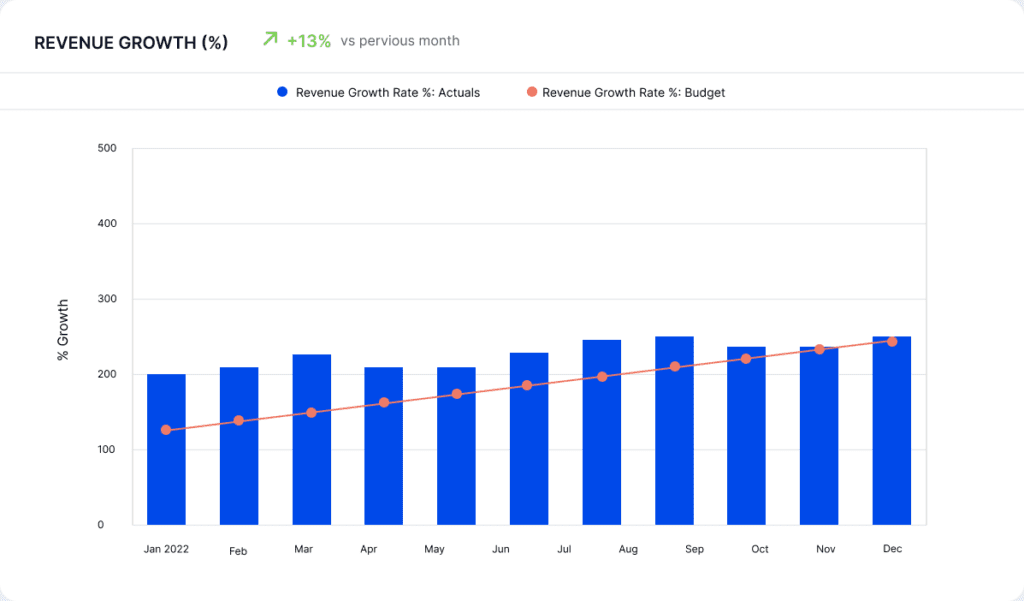
ScaleXP automates both revenue growth rate and MRR growth rate. It connects to your accounting and CRM systems and uses text recognition to build a full suite of SaaS metrics.
Yes, 20% annual revenue growth is close to the 2026 median for B2B SaaS, which is 22% overall, 20% for bootstrapped companies and 25% for equity-backed companies. Context matters, though: companies growing over 50% carry 73% more revenue per head than moderate growers and post a median Rule of 40 of 57. Growth has fallen for four consecutive years, so investors reward efficient growth. ScaleXP calculates revenue growth rate automatically from the ledger, so finance teams can benchmark growth with figures that match the financial statements.
Yes, ScaleXP calculates revenue growth rate automatically from Xero, QuickBooks or Zoho Books, comparing any period with the prior period or the same period last year. Recurring and non-recurring revenue are separated, so finance can see whether growth comes from subscriptions or one-off fees. With HubSpot, Salesforce or Pipedrive connected, ScaleXP also shows growth by customer and segment. Finance teams stop calculating revenue growth in spreadsheets and get a figure prepared daily alongside 30+ other SaaS metrics.
ScaleXP keeps SaaS revenue growth consistent with the financial statements because growth is calculated straight from the ledger in Xero or QuickBooks, with IFRS 15 and ASC 606 revenue schedules keeping revenue in the right period. Deferred and accrued revenue journals are prepared for finance to review before posting, so reported revenue is right before growth is measured. Fraser, Chief Finance and Strategy Officer, says ScaleXP “has reduced our month-end close process timeline by 50% enabling us to focus on the “so what” rather than rushing to prepare the monthly information pack.”
ScaleXP turns revenue growth rate into a board-ready story by showing growth alongside its drivers, including new customers, expansion, churn and budget vs actuals, in live dashboards and PowerPoint board packs. AI dashboards and the AI report builder help finance teams assemble the reporting, and presentation mode lets directors drill down to the customers and accounts behind the numbers. ScaleXP also puts growth next to efficiency metrics such as the Rule of 40. The outcome is a growth narrative investors trust, delivered without late nights at month-end.
Divide current-period revenue by prior-period revenue and subtract 1. For example, $1.2M this year against $1.0M last year is 20% growth. Use periods of the same length and track recurring revenue separately from one-off revenue.
For Xero, QuickBooks and Zoho Books
ScaleXP shows the headline growth rate and the transactions, customers and revenue streams driving it. Finance gets a number that reconciles and an explanation ready for the board pack.
From ledger movement to growth insight
ScaleXP imports the revenue records required for consistent period comparisons.

Predictable revenue that a company can expect to receive on a monthly basis from its subscription-based products or services.

Predictable revenue that a company can expect to receive on an annual basis from its subscription-based products or services.

Percentage of recurring revenue lost due to both cancellation and downgrades
““producing more insights, faster and with greater accuracy”
SaaS metrics
ScaleXP calculates revenue growth and 30+ other SaaS metrics straight from your accounting and CRM data.
In a 15- or 30-minute demo, we’ll show the relevant workflows using example data and discuss how they could apply to your finance process. Complex requirements? Discuss them with us first.